Update
We held a briefing on this case on Wednesday, February 25, 2026. Here is a recording.
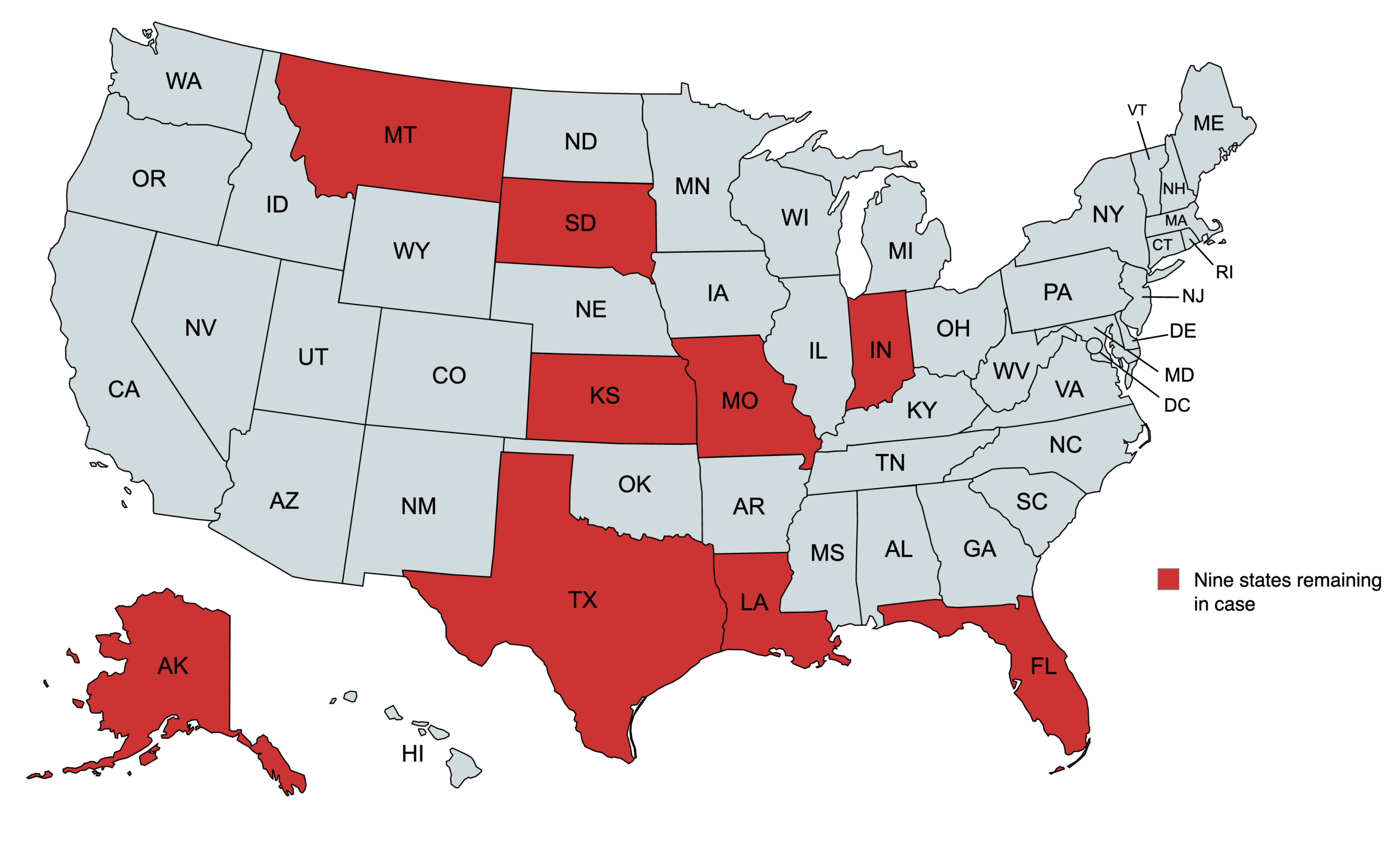
On January 25, 2026, nine states – Alaska, Florida, Indiana, Kansas, Louisiana, Missouri, Montana, South Dakota, and Texas – renewed their attack on Section 504 and the right to live in the community. The nine states say that a rule about the integration mandate published by the Department of Health and Human Services (HHS) is unlawful and unconstitutional. The integration mandate is also called Olmstead, from a 1999 U.S. Supreme Court case that ruled that unjustified segregation of disabled people in institutions violates federal disability rights laws. The nine states ask that the federal court block the integration rule and all of the Section 504 regulations that were updated in 2024.
This attack on Olmstead is happening just as DREDF and its partners are documenting the “Olmstead effect” – how implementation of the “integration mandate” has led to a significant reduction in the number of disabled people who are institutionalized or at risk of institutionalization, and has motivated system change that allows the services many disabled people need to live successfully in the community.
Keep reading to learn about this harmful case that threatens our rights.
This page explains how Texas v. Kennedy (previously Texas v. Becerra threatens Section 504, why Section 504 is important, and what you can do to help. You can learn What the lawsuit Texas v. Kennedy is and Why it Matters, What Section 504 is and why it matters, What the 17 States Want, What You Can Do to Help, How to Contact Your State Attorney General. There is an Example Letter / Email, and a Call Script.
What is Texas v. Kennedy (2026)? Why Does it Matter?
Texas v. Kennedy (previously Texas v. Becerra) is a court case in Texas that was filed in Texas in September 2024. A group of 17 states sued the United States government. The 17 states were Texas, Alaska, Alabama, Arkansas, Florida, Georgia, Indiana, Iowa, Kansas, Louisiana, Missouri, Montana, Nebraska, South Carolina, South Dakota, Utah, and West Virginia.
The complaint asked the court to get rid of Section 504 and its updated rules from 2024 that protect people with disabilities from discrimination in health care and human services. The case changed over time, in part due to the 2024 election and subsequent steps by the Trump Administration, and in part due to the advocacy of the disability community.
On January 25, 2026, nine states – Alaska, Florida, Indiana, Kansas, Louisiana, Missouri, Montana, South Dakota, and Texas – filed a new complaint, Texas v. Kennedy (2026). The nine states renewed their attack on Section 504 and the right to live in the community.
- The nine states say that a rule about the integration mandate published by the Department of Health and Human Services (HHS) is unlawful and unconstitutional.
- The nine states are asking the federal court to block the rule about integration and all of the Section 504 regulations that were updated in 2024.
What is Section 504? What are Section 504 rules?
Section 504 is an important law that protects people with disabilities. Section 504 covers all parts of society that get money from the United States government.
Section 504 says you can’t discriminate against disabled people if you get money from the United States government. Section 504 says you cannot treat people badly or exclude them because of their disabilities. It says you must include people with disabilities in programs and provide reasonable accommodations. It says you must provide services to people with disabilities in integrated settings. This means providing services in the community instead of only in institutions like hospitals and nursing homes.
Section 504 has rules that explain what disability discrimination is. The rules say that places like schools, hospitals, and doctors’ offices have to include people with disabilities. The rules say what these places have to do to include people with disabilities. The rules say that state and local healthcare, mental health, and disability agencies have to think about people with disabilities and make sure they can get services in the community and not just in institutions.
The United States government finished the first Section 504 rules in 1977. Many disabled people protested so that the government would make the rules strong.
The United States government updates the Section 504 rules over time. The government did an update in 2024. Many disability advocates wrote to the government about what to put in the rules. The updated rules are stronger and have more examples about what disability discrimination is. The updated rules gave more explanation about how state and local agencies must make sure that people with disabilities can get services in the community and not be forced into institutions.
What are the latest updates on the lawsuit?
January 25, 2026 Amended Complaint
Nine states – Alaska, Florida, Indiana, Kansas, Louisiana, Missouri, Montana, South Dakota, and Texas – filed an amended complaint. The amended complaint says that HHS’s rule about the integration mandate – the right of disabled people to get services in the community instead of institutions – is unlawful and unconstitutional. It asks the court to block that rule and all of the updated Section 504 regulations. The other eight states dropped out of the case. You can read more in our statement.
January 9, 2026 Status Report
The parties filed another Joint Status Report. The report noted that HHS published a proposed rule to amend the Section 504 regulations to say that gender dysphoria is not a disability. DREDF and many other disability organizations opposed this rulemaking.
The states said that they are considering their claims in light of this rulemaking. The parties asked the court to continue the “stay” or pause in the case. The parties said they would file a new report 14 days after the publication of a final rule.
What is the deadline for amicus briefs to support Section 504 and its regulations?
Right now, there is no briefing schedule. This means that there is no deadline for amicus briefs. If and when there is a briefing schedule, we will make sure that the views of the disability community are represented before the court.
What Can I Do to Help?
Tell Your State Attorney General to Stop Attacking Section 504
If you live in one of the nine states that are bringing the case, you can ask your state Attorney General to drop out of the case. You can ask them to drop out of the case in a meeting, in writing, or on the phone. You can ask by yourself or in a group. A group of people can be powerful. You may find a group in your community. You can ask disability groups like your local Center for Independent Living or a chapter of the Arc.
How to Contact Your State Attorney General
If you live in one of the nine states that is part of the lawsuit, you can contact your state Attorney General and tell them to drop out of the case. The red states in the image are the states bringing the case:
The contact information for each state Attorney General involved in the case is available on this page. Or use this list with the contact information for all 50 state Attorney Generals.
If you write a letter to your state Attorney General, you can follow this format:
- Say who you are. Say your name or the name of your group. Say where you live. If you want, you can say what your disability is.
- Say why you support Section 504 and its rules. Talk about why Section 504 and Olmstead are important to you. Section 504 and its rules make sure people with disabilities are included. Section 504 allows us to live and participate in our communities instead of in nursing homes, hospitals, or segregated classrooms.
- Include personal details. You can tell a personal story about why Section 504 and Olmstead matter to you. You can talk about how you or someone you love is able to live in the community with supports instead of in a nursing home or hospital.
- Say why Texas v. Kennedy (2026) is bad. If the court agrees with the states bringing the lawsuit, people with disabilities will lose civil rights. These rights have protected people with disabilities for over 50 years.
- Tell your state Attorney General to drop out of the case. If you live in a state that is part of the lawsuit, tell your Attorney General to stop attacking Section 504 and its updated rules and pull out of the lawsuit.
- If you want, ask for a meeting. Say that you and your group would like to set up a meeting to talk about why Texas v. Kennedy hurts people with disabilities.
Alaska
Attorney General Stephen J. Cox
- Email: attorney.general@alaska.gov
- Address: 1031 West 4th Avenue, Suite 200, Anchorage, AK 99501
- Phone: 907-269-5100
- Alaska’s Website Contact Page
Florida
Interim Attorney General James Uthmeier
- Email: cate.mcneill@myfloridalegal.com (Deputy Chief of Staff)
- Address: Office of the Attorney General, State of Florida, PL-01 The Capitol, Tallahassee, FL 32399-105
- Phone: (866) 966-7226 or (850) 414-3300
- Florida’s Website Contact Page
Indiana
Attorney General Todd Rokita
- Email submission form
- Address: Indiana Government Center South, 302 W. Washington St., 5th Floor, Indianapolis, IN 46204
- Phone: (317) 232-6201
- Indiana’s Website Contact Page
Kansas
Attorney General Kris Kobach
- Email submission form
- Address: 120 SW 10th Ave. 2nd Floor, Topeka, KS 66612
- Phone: (785) 296-2215
- Kansas’ Website Contact Page
Louisiana
Attorney General Liz Murrill
- Email: constituentservices@ag.louisiana.gov
- Address: 1885 North Third Street, Baton Rouge, LA 70802
- Phone: (225) 326-6079 or (877) 297-0995
- Louisiana’s Website Contact Page
Missouri
Attorney General Catherine L. Hanaway
- Email submission form (scroll down to “Questions”)
- Address: Missouri Attorney General’s Office, Supreme Court Building, 207 W. High St., P.O. Box 899, Jefferson City, MO 65102
- Phone: (573) 751-3321 (dial 711 to connect to a relay service for hearing/speech disabilities)
- Missouri’s Website Contact Page
Montana
Attorney General Austen Knudsen
- Email: contactdoj@mt.gov
- Address: P.O. Box 201401, Helena, MT 59620-1401
- Phone: (406) 444-2026
- Montana’s Website Contact Page
South Dakota
Attorney General Marty Jackley
- Email submission form (Scroll down to “Contact us by E-mail”)
- Address: Office of the Attorney General, 1302 E Hwy 14 Ste. 1, Pierre, SD 57501-8501
- Phone: (605) 773-3215
- South Dakota’s Website Contact Page
Texas
Attorney General Ken Paxton
- Email submission form
- Address: Office of the Attorney General, P.O. Box 12548, Austin, TX 78711-2548
- Phone: (512) 463-2100
- Texas’ Website Contact Page
Example Letter / Email
Here is an example of an email to a state Attorney General asking them to drop out of the case:
To: [attorney.general@alaska.gov]
Subject: Stop Attacking Section 504! Drop Out of Texas v. Kennedy!
Dear Attorney General [Stephen J. Cox],
[Say who you are] I live in Juneau, Alaska, and I have a disability. I am hard of hearing and use a wheelchair. I volunteer for the Southeast Alaska Independent Living Center. I go to college part-time. I have a personal care assistant who helps me with bathing, dressing, and eating.
[Say why you support Section 504 and its rules] I can live in my own place like other people with the help of my personal care worker. I care about Section 504 and Olmstead. I can go more places in my wheelchair because of Section 504. I can go to the doctor and use a scale for people who use wheelchairs. I can get captions for my college classes.
I support the updated Section 504 rules. The updated rules are stronger and give more examples of what disability discrimination is.
[Say why Texas v. Kennedy is bad] I am very upset and angry that you are part of the Texas v. Kennedy case. You are asking the court to get rid of Olmstead and the Section 504 rules. If the court does what you ask, I will not have equal rights anymore. I will not be able to go to the doctor or my college classes and get equal treatment. I will not have the right to live in the community with supports like my PCA. This will be true for all the other disabled people in Alaska.
[Say you want them to drop out of the case] I want you to drop out of Texas v. Kennedy. You should support Section 504 and its rules. You should not be attacking our rights.
[Ask for a meeting] I want you to meet with me and other people with disabilities. We want to talk to you about the case and why we are so concerned about it.
Sincerely,
[Your name]
Call Script (For Attorney Generals Signed On to the Case)
My name is [your name], and I live in [your city, your state].
I am a person with a disability. [Say more about your disability].
I am very upset that you are part of the Texas v. Kennedy case. This case is asking a Texas court to get rid of Olmstead and the Section 504 rules.
Section 504 and Olmstead are extremely important to the disability community. Section 504 and its rules make sure people with disabilities can be included in schools and can see their doctor. Section 504 and its rules mean people can live in the community with supports and not be forced into institutions.
If the court agrees with the states bringing the lawsuit, people with disabilities will lose civil rights. These rights have protected people with disabilities for over 50 years. This is NOT OK!
If you care about the disability community and do not want to tear down Section 504, drop out of the lawsuit NOW!
Thank you,
[Your name]
Prior Case Updates From 2025
October 27, 2025 Status Report
The parties filed another Joint Status Report. The parties asked the court to continue the “stay” or pause in the case. HHS said again that they “plan to release additional details regarding rulemaking plans related to Section 504 in the near future.” The parties said that the lawyers for HHS cannot work right now because of the government shutdown. The parties said they would file a new report on January 9, 2026.
July 29, 2025 Status Report
The 17 states and HHS filed a Joint Status Report asking the court to continue the pause in the case. HHS said in the report that they “plan to release additional details regarding rulemaking plans related to Section 504 in the near future.”
April 11, 2025 Status Report
The parties filed another Joint Status Report with the court. You can read more about the April update. This report made a big change to the states’ claims about Section 504. It said:
Plaintiffs further clarify that they have no intention to seek any relief from this Court on Count 3 (Section 504 is Unconstitutional) of their Complaint [or] their Demand for Relief at d–e [declare Section 504 unconstitutional and block HHS from enforcing Section 504]. And nothing in Plaintiffs’ Complaint seeks to … prevent the Federal Government from allocating spending or applying the provisions of the Rehabilitation Act to any recipients of such funds.
This means the states have abandoned their constitutional challenge to Section 504. This means that the district court in Texas will not rule on whether or not Section 504 is constitutional. The question of whether Section 504 is constitutional will not go to the Fifth Circuit Court of Appeals or the U.S. Supreme Court.
April 10, 2025 HHS Clarification
HHS published a “clarification” in the Federal Register. The clarification states that the language about gender dysphoria in the preamble to the updated Section 504 regulations “does not have the force or effect of law” and “cannot be enforced.” For background, HHS had previously reviewed a court case that found that gender dysphoria can be a disability under federal law. At the time, HHS wrote that gender dysphoria could be a disability. But now HHS leadership is saying that people with gender dysphoria are not protected by Section 504.
We are upset that the Administration is trying to take rights away from transgender people. The disability community includes transgender and gender-nonconforming people. Section 504 protects people with any disability. The HHS document does not change existing case law that protects transgender people with disabilities. We will continue to advocate for the rights of transgender people, with and without disabilities.
February 19, 2025 Status Report
The parties filed a Joint Status Report. The report made clear that all 17 states continued to argue that Section 504 is unconstitutional. You can read this explainer from disability advocacy organizations about the February status report.
Resources About the Section 504 & the New Section 504 Rules
- New Section 504 rules | Administration on Community Living
- New Section 504 and 1557 Regulations | American Association for People with Disabilities
- Documentary: Crip Camp: A Disability Revolution
- Video: The Power of 504

Our ability to maintain and provide these resources is made possible by the Puffin Foundation.