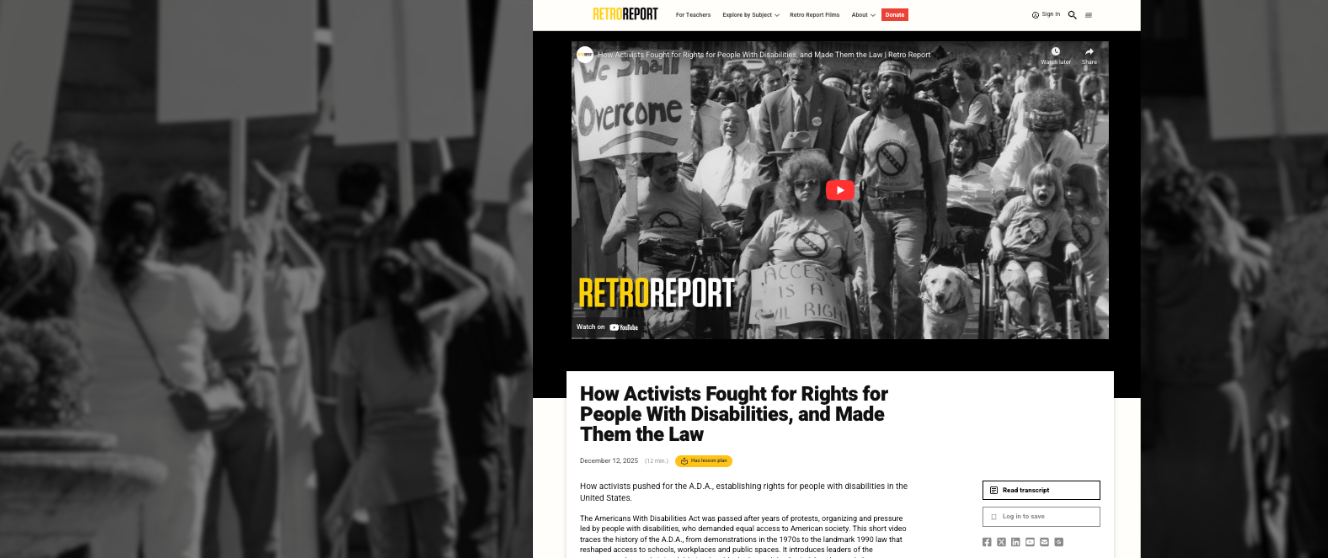

The Disability Rights Education and Defense Fund (DREDF) is featured in a new Retro Report short film, How Activists Pushed for the A.D.A., which documents the movement that won one of the most important civil rights laws in U.S. history. Retro Report is an independent nonprofit newsroom that creates documentary videos and classroom resources.
The film traces the decades-long fight that laid the foundation for the Americans with Disabilities Act, highlighting activism from the 1970s to its passage in 1990. Archival footage and first-hand accounts highlight the role of legal advocacy, policy work, grassroots organizing, and civil disobedience – including protests, occupation of federal buildings, blocking buses, and climbing up the steps of the U.S. Capitol. These efforts, led by disabled organizers and activists, combined strategy, determination, and community power to demand equal access to schools, jobs, transportation, and public spaces.
As DREDF’s co-founder and Senior Policy Advisor, Mary Lou Breslin explains in the film, people with disabilities were treated as second-class citizens and excluded from everyday life: “I became disabled as a young kid and I got polio, and there really were very, very few opportunities. Kids were not integrated in public schools at that time. The communities were architecturally inaccessible.”
The video highlights how cross-disability grassroots activism and policy advocacy came together. DREDF co-founder Pat Wright explains that non-disabled people and unfair assumptions had long shaped disability policy: “My goal for the ADA was to integrate people into society, period,” Wright says. “Whether you were blind, deaf, had a physical disability, a mental disability – that all people belonged in society.”
The film also shows how the ADA transformed daily life, from accessible buses to legal protections that opened doors to work, education, and community living. At the same time, it makes clear that these gains are not guaranteed. Present and persistent ongoing threats to Medicaid and other supports put independent living and full participation at risk.
The film concludes with a reminder that disability rights were not given; they were won, and they must be defended. Wright warns, “So far, ADA has held up. I’m sure we’re going to lose it. But, you know, I can’t stop that. It’s up to the next generation to fight for.”
As the next generation of disability rights leaders, the call is clear: Learn this history, organize in your communities, and carry the movement forward so that the promise of the ADA remains real for everyone.