
Webinar Recording
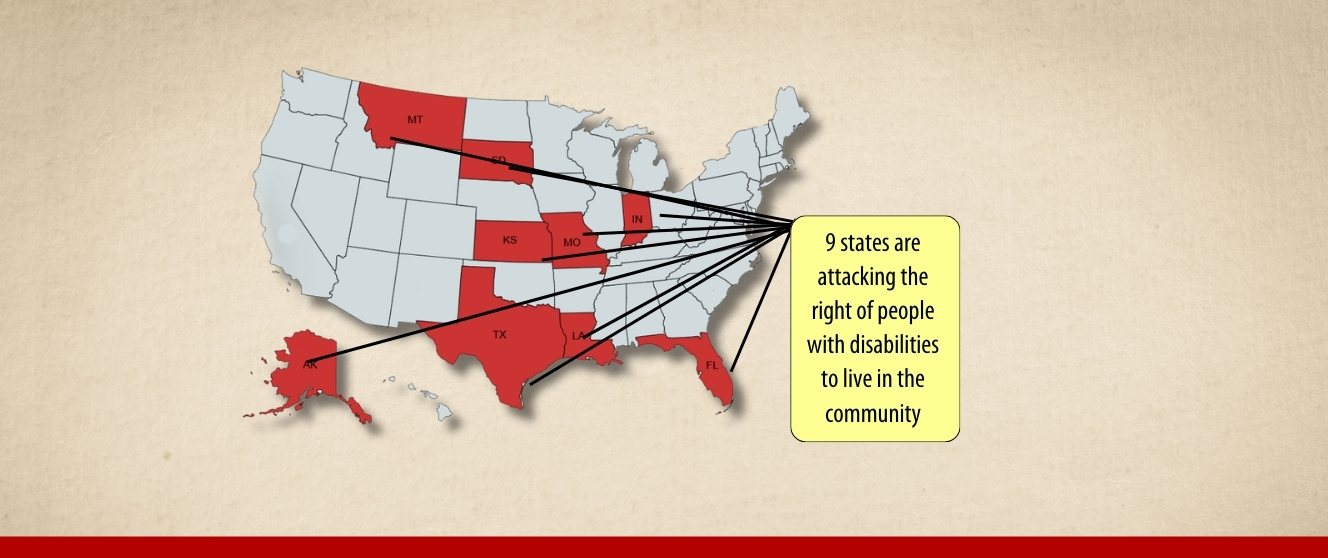
Nine states – Alaska, Florida, Indiana, Kansas, Louisiana, Missouri, Montana, South Dakota, and Texas – have renewed their attack on Section 504 and our right to live in the community. In Texas v. Kennedy (2026), the states say that the updated Section 504 rules are unlawful and unconstitutional. They want to weaken the “integration mandate” — the rule that people with disabilities have a right to live in the community with supports and not be forced into nursing homes and hospitals. This webinar includes ways to fight this dangerous plan to take away our human rights.
Presenters:
-
- Claudia Center (she/her), Legal Director, Disability Rights Education & Defense Fund
- Maria Town (she/her), President and CEO of the American Association of People with Disabilities
- Jennifer Mathis (she/her), Deputy Director, Bazelon Center for Mental Health Law
- Theo W. Braddy (he/him), Executive Director, National Council on Independent Living
- James Meadours (he/him), President, Texas Advocates
- Mike Oxford (he/him), ADAPT Organizer
Transcript
CLAUDIA CENTER: Hi, everyone. Welcome to DREDF’s informational briefing on Texas vs. Kennedy (2026).
This is a case filed in Federal Court in the Northern District of Texas against the updated HHS Section 504 rules and against Olmstead and the right to live in the community. Next slide.
I’m pleased to be joined on this webinar with amazing colleagues and advocates. We have Theo Braddy, the executive director of the National Council on Independent Living. Jennifer Mathis, deputy director for Bazelon Center for Mental Health Law. Jim Meadours, past president Texas Advocates and a life‑long self‑advocate and activist. We have Maria Town, president and CEO of American Association of People with Disabilities. And we have Mike Oxford, an ADAPT organizer, another life‑long activist and lives in Kansas, which is one of our states that is bringing this case. Next slide.
So, the topics we’re going to cover today in about an hour and a half include what is Olmstead? What do we mean when we say Olmstead?
And how does Olmstead help us? What is Section 504? And what are the Section 504 rules? What is Texas vs. Kennedy (2026)? And why is this case harmful to us? What can we do to defend Section 504 and Olmstead? And here, we’re going to hear from Kansas and national disability organizer Mike Oxford who I mentioned before.
Then we’re going to hear from disability leaders about Texas vs. Kennedy, including Maria Town, Theo Braddy, and Jim Meadours. And then assuming we have some time left, we will have some questions and answers. Next slide.
So I’m going to start us off by just doing some very basically overview about what is Olmstead. Olmstead is the name of a 1999 U.S. Supreme Court case about two women with disabilities, Lois Curtis and Elaine Wilson, and this case held that the unnecessary segregation of people with disabilities in institutions, that that is a violation of federal disability rights laws, that it’s disability discrimination.
And the court said that the states need to provide community‑based services when people are able to live in the community with supports. So, Olmstead is a word that we use. It’s a case, but we use it to say, to describe, the right to live in the community with supports. And sometimes we call it the integration mandate. A lot of words, but basically living in the community with supports. Next slide.
So, there are two, at least two pieces to the Olmstead rule, to the integration mandate. The states must provide community‑based services so that disabled people can leave institutions, if they want to, and they can live in the community. And also so that disabled people are not forced into institutions if they can stay in the community. So, both of those. We kind of bring people out of institutions and we keep people from going into institutions. Next slide.
So, here’s a picture of the first type of Olmstead situation that I just described. So Olmstead says that you have to provide people with disabilities with supports to let them leave institutions to live in the community, if they want to do that and if they can do that. So this is a picture of an institution on the left. And then an arrow with supports, to allow people, pictured on the right, to live in communities. Next slide.
And then here is another way that Olmstead helps us stay in the community. So, Olmstead requires there to be supports in the community to help people stay in the community. So, we want to stop people from getting forced out of the community into institutions. So, here we have a picture of people in the community. We want to provide people with disabilities in the community with supports, so that they’re not pushed into an institution so we don’t want to cause harm and to prevent it and Olmstead stays we want to provide supports into the community. Next slide.
We know that Olmstead helps change the way that we deliver disability services and supports and helps keep people in the community. DREDF just, and its partners, just released a report showing how in three states, Olmstead enforcement has strengthened community‑based services and supports, including support of housing.
And next slide. And I believe I’m turning this over to Jennifer Mathis now.
JENNIFER MATHIS: Thanks so much, Claudia. So, how do we know what Olmstead means? Claudia talked about how Olmstead was a decision of the Supreme Court, from 1999 about the integration mandate, which is the right to live in the community and the most integrated setting appropriate, the right to get services in the most integrated setting.
And before the Supreme Court decided that in 1999, that requirement had been in regulations for a long time. We’re going to talk about that, since the 1970’s and actually some of us were part of cases, worked on cases before 1999 that actually went to court, saying that people had rights under the integration mandate, and got people those rights under the integration mandate under the Americans with Disabilities Act and under Section 504.
And so in 1999, the Supreme Court took up this issue and made it very clear, in case there was any doubt, that this was the law of the land; that the ADA and the Supreme Court’s Olmstead decision was about the ADA, but Section 504 has the same requirements as the ADA, and so Section 504 as well has an integration mandate that requires that ‑‑ well, we’ll talk a little bit about the requirements first.
But I just ‑‑ I want to highlight that this is the integration mandate is supported by many, many years of law. So, 1999 was when the Supreme Court made clear it was the law of the land. And then since then, in the 27 years since, we have had so many court decisions and agent findings and settlement agreements and guidance documents; all of these well ‑‑ all of these pieces of guidance from the Government and from the courts have made it very clear what the law means. That’s how we know what Olmstead means.
For more than 25 years of experience and, really, more than that, but starting with the Supreme Court’s decision in Olmstead in 1999, we are now 27 years past there and we have almost three decades of law interpreting the principles of the integration mandate.
And many people with disabilities have even grown up with Olmstead as sort of the backdrop of, you know, what their lives have looked like, and take for granted the right to live in the community with supports and the right to participate in programs, receive services, with non‑disabled people, whether that’s in school, whether that’s in employment settings, or other settings. Next slide.
So, let us back up a little bit to explain the basics of Section 504. Section 504, as many of you know, is one of our foundational Disability Rights laws. It was passed in 1973 as part of the Rehabilitation Act. And this has turned out to be an incredibly important law.
It was very short; it was just a few paragraphs, a few sentences, really. And it said that programs and activities, groups that get federal money from the U.S. Government can’t discriminate against disabled people. It also later was amended/changed to apply also to federal agencies, so that federal agencies also can’t discriminate against people with disabilities.
And even though that law is pretty short, it has become the foundation for all of disability rights law. There are many more details that are in the Section 504 rules that every federal agency has issued, HHS and other agencies, and in many, many court cases, over the years, since 1973, when Section 504 was first cast. So, those rules and court decisions really became the foundation for later disability rights laws, like the ADA, the Fair Housing Amendments Act and other laws. So Section 504 is short, but very, very important. Next slide.
So, the Section 504 rules, as I said, every agency has adopted regulations that implement, that give some life to the law, to Section 504. That was what Congress required them to do in Section 504. And HHS’s rule was first adopted in 1977, and I would just say that ‑‑ and it was actually at that point Health and Education and Welfare, HEW.
Many of you are aware of the history of how we got the Section 504 rules after massive protests by people with disabilities around the country, because the Government had failed to issue rules for a number of years.
And so there were protests, including an occupation of the HEW Building in San Francisco that lasted for a very long time; for more than a month. And was the longest occupation of a federal government building in history. And so this was basically hard fought to get these rules. And there is a picture in the slide showing those protests. I think that is a picture that was taken from inside the HEW Building by people who are in there, looking outside at the people protesting.
And so those rules that HHS, then HEW, but now HHS issued that apply to the programs and activities that get their money, that get money from HHS, included a lot of topics. And they included the integration mandate. They said that services had to be provided in the most integrated setting appropriate to a person’s needs. Next slide.
Okay. So, what are the Section 504 rules Part 2, which is where are we now with the Section 504 rules? So, we talked about HHS having issued a rule back in 1977, which was almost 50 years ago, and so because that rule was so old at this point and really didn’t reflect so many developments in the law that were so important, HHS went, during the last Administration, and developed an update to that rule.
And that updated rule was issued in May of 2024. And that rule, as many of you remember, was done, really, with many, many requests from the disability community, because it was so important to the community that the rule be updated, and that it include topics that hadn’t been in the old rule, because the old rule was from 1977.
And so there was massive interest from the community. There were over 5,000 comments from ‑‑ largely from people with disabilities and disability community organizations, but also from the people and entities that are regulated by the rule.
HHS took into account all of those comments and changed ‑‑ made changes in response to those comments, to make the rule better, when it made the final rule.
And so what the final rules do is they apply principles of disability, non‑discrimination, in two ways. So, first off, they update some basic things that needed to be changed based on changes in the law for the last almost 50 years. So, the rules now say people with disabilities are disabled people instead of saying handicapped people, because that was a change in the law that was made in those intervening years.
They also incorporated changes made to strengthen who’s covered by the law that were made by the ADA Amendments Act and so those changes were made. And there were lots of changes like that that were just updating to account for how the law changed by decisions of the Supreme Court and by Congress’s changes. And then in addition to that, there were a number of new areas that HHS addressed, and those included, for example, areas like accessible websites and accessible medical equipment.
And also, the rules included a section, an updated section on the integration mandate. The old rule did have an integration mandate, as we talked about, from 1977, but in 2024, what HHS did was add a short section, with a few paragraphs, just putting in some very basic, well‑established principles of law that had developed under the integration mandate since 1977. Next slide.
So, with the updated rules on the integration mandate, they flushed out a little bit more some principles of law. So, for example, they said groups and states ‑‑ it’s mainly states that ‑‑ states and local governments that are usually the ones who are at issue in integration mandate cases ‑‑ but states and others that get federal money from HHS have to run programs “in the most integrated setting appropriate to the needs of the disabled person.”
That was things there already from 1977 but they clarified already clarified community services that caused a risk of institutionalization and those are among the things that are prohibited. That doesn’t mean that any time somebody fails to provide those services they automatically violate the law. This is a defense. But those are the types of things that are types of discrimination under the law. And HHS defined what the most integrated setting means, to give a little more clarity.
Again, this is based on years of case law and guidance from agencies, from DOJ, from HHS. So they said the most integrated setting appropriate includes providing an opportunity to live, work, and receive services in mainstream society, and to give individuals choice in their daily life activities. They also defined what a segregated setting is. And all of the things that are in the new 2024 integration part of the rule, again, are based on years of court cases and agency findings and guidance.
Nothing, like, new and different that they were making up for the first time in 2024. Next slide.
Okay. And then in addition, I just want to highlight that besides the integration mandate there were a number of other areas that the HHS, the new rule, addressed that weren’t addressed, necessarily, in the original rule.
So one of those was discrimination in medical treatment. The slides mention the Michael Hickson case, and that was a case that many folks are aware of and followed, where a Black man with significant disabilities was denied medical care, life‑saving medical care during COVID, where a doctor had said ‑‑ suggested that the value of his disabled life was not worth saving and was not as valuable as the life of a person with a disability ‑‑ without a disability.
So, those medical treatment discrimination provisions really are about things like organ transplantation and things like crisis standards of care, different distinctions in medicine and medical treatment where doctors and other medical professionals make decisions that are based on bias, that are based on stereotypes, that are based on assumptions that the value of a disabled life is not as good as the value of a non‑disabled life. And so the rule talks about that and when it is discrimination in medical treatment to treat somebody with a disability that way. And then the rules talk about accessible medical equipment. They set standards. Also for accessible websites and mobile apps. They talk about effective communication. They talk about reasonable modifications. Those areas were in the original regs from 1977, but they flesh out a little bit more, given all of the law over the past decades. And the rules also apply to child welfare agencies and programs.
So, this gives you an idea of the breadth of the HHS rule. Very, very important, touching many, many core areas that are so important to the disability community, where people have experienced discrimination in a pervasive way and where people have been left behind and it was really, really critical for the agency to issue these rules. Next slide.
So, in 2026, last month, in February, Texas and eight other states filed a new version of a case in Federal Court, in Texas, in the Northern District of Texas that challenged the HHS rule.
DREDF has done a lot of work and did a webinar in the past talking about the original version of this lawsuit, explaining what was going on. And now we are dealing with the new version of this lawsuit, it’s called an amended complaint, where a number of the states have dropped out, but Texas and nine other states are continuing to sue HHS and challenge this 504 rule. And what they are laser‑focused on in this new version of the lawsuit is the integration mandate. And these states are saying the updated rule on the integration mandate is unlawful and unconstitutional.
We wholeheartedly disagree with that. We think they are wrong. But this is very, very important. And even though they may be wrong, this is a very, very dangerous lawsuit. So, we want everybody to be aware of what’s going on. Next slide.
Okay. So, what are the nine states saying about HHS’s rules? They say that HHS overstepped in their job to interpret the law under Section 504. They say they went beyond what the law requires. They say the rule puts too many ‑‑ too many different restrictions on states for taking federal money, so it’s unconstitutional. They say it’s coercive, essentially, that it forces states to do things that they don’t want to do.
They say it’s a surprise to states; that states wouldn’t really have any idea when they took federal money, that they had to do the things that the integration provisions say.
They say the rule is arbitrary and capricious. That’s a legal standard under the Administrative Procedures Act, that’s one of the laws that they’re using to sue. And they say it is arbitrary and capricious because they say it conflicts with Medicaid.
Of course, the rule does not conflict with Medicaid at all. This was actually an argument that the states made in the Olmstead case when Olmstead was in the Supreme Court, and that is not what the Supreme Court said. And they fault HHS for somehow not coming up with other solutions to these problems. But, of course, what HHS was doing was what Congress said in the law.
So, they also, they said, talk about this conflict that they think exists with Medicaid. They say that Medicaid is really focused on medical and institutional care and it’s not about community‑based services. We want to highlight that that is not true. In fact, that is an argument that Georgia made in the Olmstead case in the Supreme Court. And I just want to take a minute to read what the Supreme Court said about that.
The Supreme Court had said: The State, Georgia, is urging that the Medicaid law reflected a congressional policy preference for treatment in the institution over treatment in the community.
And the Supreme Court said: The State correctly used the past tense; in other words, that is no longer true. Because since 1981, Medicaid has provided funding for home and community‑based services, through a waiver program and through other options. And so it is simply not true. The Supreme Court itself has said that it is not true, that Medicaid is focused only on institutional care.
And then the last thing that the states are saying is that they should not have to prevent people from being at serious risk of institutionalization. They shouldn’t have to do the thing that Claudia was talking about and keep people out of institutions in the first place, and let them stay in the community. They’re saying if people are in the community now, they have no rights under Olmstead.
And they have to wait until they get into an institution before they have any rights. Even if the state basically forces them to go into an institution, by not giving them the community services that they need and only offering an institution. Next slide.
So, I’m going to describe these pictures again. Claudia described these pictures before. One is a picture on the left of people with disabilities in the community and there is an arrow under that that says “nine states say it is lawful to push people ‑‑ push disabled people from the community into institutions” and the arrow is pointing towards a picture of a hall in an institution.
And, again, we disagree with that. We think there is well‑established law that aside from the Fifth Circuit, there was one court that said that the ADA and 504 do not allow people to sue when they have been placed at serious risk for institutionalization. Every other court has said otherwise, every other court, for years and years. So, we don’t believe that Texas and the other eight states are correct about this. Next slide.
Okay. And here, again, is a picture of that hall in that institution, and it says “Nine states say you have to be here, pushed into an institution, before you can get any help from Olmstead.”
So, in other words, you have to wait until you’re institutionalized before you can sue. And we all know that once somebody has to wait until they get institutionalized, before they can enforce their rights, by that time, they end up losing their house, they end up losing their job, they end up losing their connections to the community.
In so many cases, it becomes so much harder for people to get out again. And plus, they shouldn’t have to go in and have their rights violated in order to do anything about it. Next slide.
Okay. So, what do the nine states want? They want the Federal Court to say that the rule is unlawful; that it violates the Administrative Procedures Act; that it is unconstitutional; and that the Court should strike it down.
The states think that the Court should block the final rule and tell HHS “stop enforcing the rule.” Now, the states also are separately asking for the Court to do something specifically about the integration provisions in the rule. So, they say HHS can’t tell states to have programs in the most integrated setting, appropriate for the disabled person, and they also ‑‑ I think that Olmstead only applies if a person is already in an institution, so they’re asking for the Court to say HHS cannot say otherwise. And so they’re asking for the Court to take away the entire rule. And then they’re also asking for the Court to take away pieces of the rule with respect to the integration provisions. And they seem to be basically hedging their bets, because if they take away the entire rule, that takes away the integration provisions too. But what we think they are doing is saying well, we take away the whole rule, but just in case we don’t win that, take away these parts of the rule. Next slide.
So, why is this so dangerous? Texas, the part of Texas where they filed the case is one Federal District Court, that’s the trial‑level court, but the case could go higher than that. Certainly if the Federal Government were to win, if Texas were to lose, then Texas would almost certainly appeal and go up to the Fifth Circuit Court of Appeals.
The First Circuit Court of Appeals is a very, very difficult court. It is well‑known as the most difficult court in the country for Civil Rights‑type claims and that has often applied to disability rights claims too. It could go to the Supreme Court. All of this is very, very risky for Olmstead and for the entire 504 rule.
The Fifth Circuit, no coincidence, is the one place that the one Court that has already said that it rejects at‑risk claims. It says you have to go into an institution first before you can enforce your rights under the integration mandate.
But beyond that, if the Fifth Circuit were to talk about what the integration mandate means, what the most integrated setting means, there are a lot of harms that could potentially come from that.
And because it could go up to the Supreme Court ‑‑ and even if it doesn’t go up to the Supreme Court, but just given other courts, looking at what the Fifth Circuit does, this case has a lot of potential to do significant harm to disabled people all over the country, not just in the Fifth Circuit, which is Texas, Louisiana, and Mississippi, but everywhere. And with that, I am going to turn it back over to Claudia.
CLAUDIA CENTER: Thank you, Jennifer. So, what are the nine states? We’re just going to go through them, and we have a map here with the nine states colored in red: Alaska, Florida, Indiana, Kansas, where we have Mike Oxford today, Louisiana, Missouri, Montana, South Dakota, and Texas, where we have Jim Meadours and actually Maria Town spent a lot of time in Texas as well. Next slide.
So, we’ve gotten some questions in the question box about, you know, what ‑‑ didn’t we do this last year? How does this relate to the case that we talked about last year, almost exactly a year ago?
And so about a year ago, we had a webinar and talked about an earlier version of this case. In the earlier version of the case, 17 states brought an action. And that action was even broader than the case we’re talking about today. That case asked the Court to say that Section 504 itself, the whole statute, was unconstitutional, and made a lot of other demands in that earlier version of the case.
And the disability community protested this outrageous attack on Section 504. There were thousands of e‑mails and phone calls made by, you know, all of us and many more out in the community.
There were hundreds of news articles. I tried to collect them all and I eventually gave up, because there were so many news articles about our protests. And thousands and thousands of social media posts.
And in April 2025, the states made a big change and said they were no longer challenging the statute itself; they really felt the power of the disability community, and they said no, we’re not gonna say Section 504 itself is unconstitutional. So, this was a big win. And we’re gonna try and, you know ‑‑ we’re bringing the band back together, we’ve got to do this again this year. Next slide.
And so why did eight states drop out recently? So, the earlier case also complained about a preamble, and that means like an introduction, to the updated Section 504 rules.
And that introduction ‑‑ so it wasn’t part of the regulations, but it was a description, and it said that gender dysphoria, which is a condition in the book that psychiatrists and psychologists use, it’s called the DSM, that gender dysphoria may be a disability covered by Section 504, depending on the facts.
And so the earlier case complained about that description of gender dysphoria and said that gender dysphoria should be excluded from any possible protection by Section 504.
So, in December 2025, HHS published a new rule, a proposed rule, that says people with gender dysphoria are not ‑‑ cannot have a disability under Section 504 and are, therefore, excluded as a group from any protections under Section 504. And many disability groups, including many that are in this webinar, opposed that rule.
But eight states then left the case and some of them explicitly said “We’re leaving the case because we’re satisfied with HHS publishing this proposed rule to exclude people with gender dysphoria.” Next slide.
Okay. And now we’re going to turn it over to Mike Oxford, who’s gonna tell us about how we can all work together and fight this awful, terrible case. Thank you.
MIKE OXFORD: Hi, thanks, Claudia, and everyone. And I don’t know, it looks like I don’t need to tell this crowd a whole lot about how to be active and fight back against things. But nevertheless, thanks for having me. I’ve been a long‑time organizer with ADAPT and with independent living centers and so on.
And so I’m really glad that you’re doing this, because this is really important, right. This is building on and getting close to a 70‑year history that could crumble backwards.
So, if you live ‑‑ this slide says “What can you do to stop this?” If you live in one of the nine states, speak up! Tell your State Attorney General to stop attacking Section 504 and Olmstead.
Tell your Governor to stop attacking Section 504 and Olmstead. Reach out to other people in your state. Work together. Make some noise. And under that, it talks and says phone calls, e‑mails, meetings, protests, articles, and newspaper, stories on TV, post on social media. Yes, so and in terms of all of these things, and we’ll talk more about that as, you know, working together, also, in some states, like mine right now anyway, our Attorney General is not exactly on the same page as our Governor.
So, I also have to say, as an aside, I appreciate that just by happenstance the nine states were all colored in red on your map, but I’m sure that’s just a coincidence of the available ink patterns.
But not all the states are all the way red or blue or whatever, right, so your Attorney General, like in my state of Kansas may not exactly be on the same wavelength as the Governor and there is a chance to use that in terms of all these other options, media, social media, letter writing and so on to raise that all up, if this is not representative of our state there.
And so… I would say, you know, the easiest thing to do is, you know, begin writing your letters. Begin making the phone calls and doing the e‑mails. Also, with all these things, in ADAPT, we always try to emphasize having fun and emphasize also building a social network.
This stuff can be kind of intimidating, if you haven’t done it or it seems a little scary or, gee, whiz, I don’t want to out myself that I’m the only, you know, progressive person in my county, you know, these kinds of things.
But if you get together and make it a little fun, you can do it online or in‑person, obviously in the old days we did it in‑person more, and have some snacks, share ideas, bring your laptops or your phones and type stuff together in a group and do that and make it social and fun.
And then you can build a group and bring more people to more of an event, to try to up your numbers, with that. And that’s the main thing I would say about all these things.
This is very intense. And it can be scary and angering and all these things. And having a group to work with locally can build your strength and help sort of smooth out some of these awful pieces that we have to go through in trying to fight back against this. Next slide.
How do we contact our State Attorney General or our Governor? So, to find your State Attorney General, there is a handy link right here from DREDF, it’s dredf.org/protect‑504#anchor6. There’s also www.usa.gov/state‑attorney‑general. To find your governor, www.Usa.gov/state‑governor.
And usually these things will take you to like a website and handy places and also other social media that you can use. And if you can, ask for a meeting. Go in person there too. By yourself or with your small group. Next slide.
How do you find people to work with? Find your state protection and advocacy agency at https://www.ndrn.org/about/ndrn-member-agencies/ are federally funded organizations and law organizations that assist people with learning, exercising, and enforcing their rights.
Find a local chapter of The Arc. It looks like The Arc, theArc.org/find‑a‑chapter/. Find your local Center for Independent Living or statewide Independent Living Council you can go to NCIL.org/about/find‑your‑cil‑list.
Check with Your State Councils on Developmental Disabilities, oh, boy, this is a long one… I’m reading these, because I thought I saw a link that the talk‑back part wasn’t working and I want to be as accessible as possible. This is getting kind of long, but anyway…. DD councils can go to ‑‑ oh, man… uh… acl.gov/programs/aging‑and‑disability‑networks/state‑councils‑developmental‑disabilities. And state councils are federally mandated, non‑partisan bodies, and you can get connected with your state REV UP Coalition and they are a group for registering to vote at www.aapd.com/revup‑join/. And if you get stuck, just reach out to DREDF, I should have just read that one and move on.
I want to put out things in your state and locally and things that’s important here, all of these different organizations can help you and especially if you go locally, but think also about self‑advocacy organizations.
Think about what we in Kansas call consumer‑run mental health organizations. Think about aging organizations. Also, think about social organizations that you might be part of or your family members. Also if you attend churches, all those things are good to be talking about these issues and finding like‑minded people. Keep in mind that even in us red states, like Kansas, about 35% of the people in Kansas identify as progressive. Actually, I saw some poll there.
So even though it looks kind of overwhelming, if you just look at the color of the participant, there are lots of like‑minded people across all political stripes around these issues. Next slide.
What do we say to our Attorney General and Governor? Withdraw from Texas vs Kennedy. People with disabilities have a right to live in the community with services and supports. This lawsuit attacks our right to live in the community. People should not be forced into institutions when they can and want to live in the community. And then our name should not be ‑‑ Kansas should not be part of this harmful lawsuit.
And, you know, with this slide, to keep in mind that a lot of this progress, it’s just interesting, because I remember when the first omnibus bill passed creating Medicaid waivers, creating HCBS that passed in 1981, and a lot of the drive behind that was coming from the Governor’s Association, from a very bipartisan mix of state officials and federal officials, because they could see the future happening and they were worried about cost effectiveness.
Because ‑‑ and that is still something that’s kind of there. We don’t want to dwell on it I think too much, but the fact is part of the Olmstead decision and part of what, you know, we’re talking about is that we had to fight for these rights. And we had to uncover the fact that it’s also a lot ‑‑ usually a lot less expensive to serve people in homes and communities. And a generation ago, there was bipartisan support for that kind of idea.
And, you know, one of the things, I’m sure the lawyers will tell me I’m wrong around this, about withdrawing is if everybody on HCBS or possibly on a list who has qualified for these programs to exercise their options to demand their mandatory benefit, states are required, at some level, meet what they’re required to do under Medicaid, it would so overload the system.
So, I mean, from a human and financial perspective there, it just so doesn’t make sense, as I saw Bob Williams saying in the chat. So keeping in mind, too, is that, you know, this is better state government, any way you want to cut it: taxpayer, programmatically, plus people, volunteer, pay taxes, do all sorts of things in the community that we benefit from.
And so please, really bring that down to your local level, if you possibly can. Because my child gets these services. This is the great stuff. Because I have gotten these services, this is the great stuff. I was able to get out of a nursing home. I was able to avoid going to a residential facility.
And finally, I just want to say to reach out. People don’t realize that most of assisted living, at least paid for by Medicaid, is also part of HCBS and, therefore, would be part of the, let’s just get rid of it. Because it’s not an institutional benefit definitionally under Medicaid. Next slide.
So, here’s an example e‑mail. I know this is going to be sent to everyone, so if it’s okay, in the interest of time, I won’t read the whole thing. But the idea is everyone is going to get a copy of this. Um… this is a just a sample what have you can write about and the issues that you can kind of bring up there. And so that will be sent along to all the participants. But, again, boil it down, how this affects me, my family, my community, my pocketbook.
And you’ll have a great e‑mail directed to your Attorney General.
Likewise, you can put the reverse in, if you have a friend, like a Governor in the State of Kansas would be friendly to us and so we would want to share. Please help us fight back against this governor, right, and that would be the play in Kansas. So you can do that with different officials too, even if they’re your friend, share what you sent to someone who you’re trying to change their mind and ask for their help. Next.
So, again, the sample goes on, giving different examples. If you possibly can, this is kind of more me for my ADAPT sense, is always ask for a meeting. They can do meetings by Zoom, too, so it doesn’t have to be in‑person, but always ask for a meeting, and then, if possible, try to include some in‑persons there. And I say that, too, because asking to meet with an elected official can help build momentum, can help build interest. And, frankly, can set you up if you’re interested in doing other things, like theater protesting, those kinds of things. Asking for a response, asking for a meeting and getting blown off is, in fact, the rationale for taking another step and doing something else and keeping on it. And plus, people will tend to relate to the fact that without regard to really what your position is, elected people are supposed to be responsive. And I’m saying this because in my state, in Kansas, more recently I have had, for the first time, a lot of trouble getting responses from elected officials.
So, that kind of, like, well, then, what do we do next? Because being blown off is not an option. Next.
And, again, to reporters, what do we say to reporters or on social media ‑‑ excuse me ‑‑ people with disabilities have a right to live in their communities, with services and supports that make life possible.
This lawsuit attacks our right to live in the community. Our state should not be part of this lawsuit. We are calling on our Attorney General to withdraw from Texas v. Kennedy, and, again, you fill that in with your story, your family’s story, and how that affects you, your dignity, your happiness, and so on, as you make these points.
CLAUDIA CENTER: So now it’s going to come back to me, Claudia. And we just want to share what you can say about Medicaid. Because the nine states are saying that the Olmstead rule, the updated rule about integration in the community is conflicting with Medicaid. And what you can say is that these AGs are being dishonest about Medicaid. Medicaid does not conflict with Olmstead. Medicaid helps states comply with Olmstead. Medicaid is the largest funder of community‑based services and supports in the United States.
Medicaid covers things like at‑home personal care attendants, adult day programs, supported employment, program‑related transportation, and so on. So they are just being dishonest. Next slide.
So, we have more resources on our resources page. Everybody who registers for the webinar will get the slide deck with all of these links. And there are more resources to come. Next slide.
Let’s pull down the slides and we’re going to hear from Theo Braddy, and then from Jim Meadours, and then from Maria Town.
THEO BRADDY: Awesome. Can everybody hear me okay? All right. I’m gonna switch it up a little bit, all right? Claudia and Jennifer did a great job in getting you all updated. And then Michael came in and got you all some information about next steps, right. I’m going to switch it up a little bit and try to get you motivated, all right.
A few years ago, I used to listen to this guy, this kid, called Kit President, right, and he started off some of his blogs by saying, “I think we all need a pep talk,” right. I think we all need a pep talk.
And that is so important here, because the stuff that Mike talked about is what you need to get excited about doing. Because that’s part of the work, right.
So, today I just want to really talk to you and give you a pep talk, all right. I won’t keep you long. I do a lot of monthly messages. And if I was doing a message on this, what I would call it “What we need to know. What we know.” All right. This is stuff that we know, all right.
We know segregation was never about doing the right thing. It was all about control. This is what we know. We know institutions were built on the belief that disability meant less standing. That we were better off hidden, managed, contained. We know what happened in institutions. We know it: Isolation, abuse, loss of childhood, loss of adulthood, loss of choice.
We also know that families were told that this is your only option. And too often, they believed it. Heck, I believed it. It is why at age 15, I lived in a nursing home for a year. We know that when people are removed from their communities, they lose more than just a physical address, they lose connection, they lose opportunity, they lose power.
We know independence is not a privilege. That it is a civil right. We know that. We know community living is not a social experiment, it’s settled law. You heard that from Claudia, you heard that from Jennifer.
We know that people with disabilities work, vote, raise children, lead organizations, and contribute to this country every single day.
Not because they was institutionalized, but because we were included. We know when services follow the person, people thrive. We know when housing is available, people succeed. We know when supports are available, families stay together. This is what we know.
We know that forced institution, we know that forced institutionalization costs more, morally and financially. Mike spoke on that.
We know that the integration mandate was not handed to us. We know this. It was fought for. It was litigated. It was won. Right? We finished that one. This is what we know.
We know every time systems say “there isn’t enough money,” what they really mean is “you are not a priority.” We know that when protection weakened, segregation grows. We know when segregation grows, harm follows.
We know children do not belong in institutions because system fails to provide supports. We know that. We know that adults do not belong in nursing homes because housing policy failed. We know that. We know that mental health crisis do not justify life‑long confinement.
We know this stuff. We know disabilities does not mean humanity. Right? It don’t erase humanity. We all have disabilities. But we’re still human beings.
We know we belong. In our neighbors, in our schools, in our workplaces, in our homes, in our houses of worships. We know that. We all want to participate in the community, in our churches.
We know that we started with 17 states, and this is the sweet thing, we now have nine. So, we know it works. We know what Michael said works.
And finally, we know this most of all: We are not going back, not to the back wards, not to the locked units, not to the institutions, not to the days when the system decided where we live. And certainly not miles away from our families. We know this. We know better. And because we know better, we will fight better.
So that’s the discharge, do the things that Mike asked you to do, and I think we will win this and eliminate these nine states. Thank you.
CLAUDIA CENTER: Wow, Theo, thank you so much! We really needed that. Let’s hear from James next.
JAMES MEADOURS: Can you do a favor for me? If I’m going over, if someone could let me, like, give me a one‑minute warning or something, that would be helpful for you.
CLAUDIA CENTER: Certainly, James, I’ll do that. This is Claudia.
JAMES MEADOURS: Thanks, Claudia, I appreciate that. I’m Jim Meadours. I know I’m from Texas, but I’m not for the person from Texas.
I think about what Justin Thorpe said that what is the most important thing in your life, it is our time to raise our voices, to go to the polls, to know who is the best person to represent your state, and to educate, to take the name off those nine states.
And even in Texas, we have a Governor’s race, we have an Attorney General’s race, and also a U.S. Senate seat, and the person who is running for the U.S. Senate seat, he is also the Attorney General, and so I would like to ask the question, the Legislature tried to impeach him because he was breaking the law
The House impeached him, but the Senate did not get the votes to impeach him. Now it is the time for us to raise our voices, to why we want to live in the community. Not in an institution.
It is embarrassment for me sometimes, to still live in Texas, because it’s hard, it’s hard for me to see my peers, people with disabilities, still moving into institutions in Texas.
Even we had the Olmstead and Section 504. Because the bureaucracy, we need to respect the parents’ wishes, but at the same time, we do not have ‑‑ they don’t find community‑based services.
As advocates, we need to fight hard and help to do what we need to do. Because our voice is so important. Because when I think of voting, because that’s another part of getting involved. Get involved with one of the candidates you feel comfortable to help you to tell them what you’re feeling of those nine states.
Because your voice, your perception, is so important. Because it’s not just my voice or to the other self‑advocate leaders, it’s each others’ voices have unique stories and perceptions. Because if we don’t do that, we fall apart. I’m worried that those ‑‑ that we will go back into the Dark Ages again. And I don’t want my peers to have to do that.
Because I lived in a group home in Oklahoma from 1987‑1992. But I raise that, because I went into different institutions in Oklahoma, Louisiana, and Texas. And it is just heartbreaking to see my peers to do so much more in the communal living, because people should live in a community. And it’s rare. My heart is broken because we still have 13‑run state institutions.
The last time they closed an institution was, like, in 1992, ’93, around that period. Because the Governor did something about it. Because we still have 13 institutions. And we need to have the power to stand up for what is right for our peers, our friends, our colleagues.
Because our representatives need to hear and not always hear the voice of reason, they need to hear self‑advocates like ourselves, to raise our voices. And even to people who we disagree, to educate, educate, educate on them. And to get self‑advocates involved with this cause. Because I know when we did the Olmstead stuff back in the day, we did have the court support Lois and Elaine and now we need to get people with disabilities to know more about what’s going on. Because it’s their lives. It’s their friends. The people they know in the community and also people in the institutions. Bring them home and live in the community.
CLAUDIA CENTER: Thank you, James, that was amazing. Maria, would you like to share with us? And we also have time for questions; we have a lot of questions. So, if we could hear from Maria and then there are some questions that we will be answering live
MARIA TOWN: Thank you so much, Claudia. And thank you to the Disability Rights Education and Defense Fund for hosting this important webinar.
My name is Maria Town. My pronouns are she and her. I’m a White woman with long brown hair, wearing a black dress and red lipstick and I serve as the president and CEO of the American Association of People with Disabilities.
So much has already been said about the importance of 504 and community integration and why we must fight to protect, defend, and advance these important rights. And at the end of the day, it comes down to one thing for me: Community integration is life‑saving and life‑affirming.
We know that people with disabilities who live and receive services in the homes and communities that they love live longer and have a better quality of life.
To get into some data, one recent study found that even when you control for people’s health and health conditions, the lifespan of people living in nursing homes get shortened by close to four years, compared to those who are not.
During the height of the now ongoing COVID‑19 pandemic, deaths of people living in nursing homes and assisted living facilities accounted for close to 40% of all COVID‑19 deaths.
For a group of people that only account for a fraction of the percentage of the U.S. population, to account for 40% of all COVID deaths in 2020, how many lives could have been saved if those folks were living in the community? Again, community integration is truly life‑saving.
This lawsuit is also happening at a time when other measures to protect disabled people living in institutions are being actively dismantled.
The Trump Administration recently rescinded a federal staffing requirement for nursing homes which would have included having a registered nurse on‑site 24/7 and guaranteeing a minimum amount of caring time for residents. But that’s gone now.
The Administration has also targeted the long‑term care omnibusman program for elimination which is the only federal program dedicated to working with nursing home residents to address complaints, protect them from abuse, and advocate for better care.
We cannot allow 504 and the integration mandate to be deemed unconstitutional at a time when nursing homes and other institutions are becoming even more dangerous than they already were.
It is surprising to me, as Mike mentioned, that states are suing and questioning the lawfulness and constitutionality of Section 504 in the community integration mandate.
When these requirements are old, while the updated 504 rule is new, the Olmstead decision is more than 25‑years‑old. HCBS waiver programs are 45 years, and Section 504 is close to 50‑years‑old.
States have had a long time to implement and operationalize the community integration mandate.
Further, as Mike mentioned, home and community‑based services are more cost effective than care in institutional settings. And while we have referenced nursing homes and institutions a lot, I want to make clear that jails are also institutions and we cannot forget about our disabled brothers and sisters in jails right now, because they couldn’t get services in the community.
States spend a lot of money on jails. Medicaid helps keep people out of jail, particularly through HCBS’s ability to fund community mental health supports. Instead of suing to get rid of the community integration mandates, states should be fighting alongside of us to protect and defend Medicaid and to get more Medicaid funding for home and community‑based services.
The nine states suing, particularly my home state of Louisiana and my own home state of Texas are frequently in budget crisis that put services that disabled people rely on in jeopardy. Again, why are they fighting against us when they should be fighting with us?
I also mention that community integration is life‑affirming. Disabled people have fought for centuries to exist in public as we are. We, disabled people, need to see one another in our communities enjoying ourselves, pursuing our passions, and more.
We need to be in community with one another, to remind ourselves of what is possible, to remind ourselves that a better future is possible, and to remind those around us that disabled lives are lives worth living.
As I close, I wanted to mention a quote from Lois Curtis, who even though she has now passed is still central to this fight. She was asked in an interview what she wishes for all of the people that she helped move out of institutions and into their communities, and she said: I hope they live long lives and have their own place. I hope they make money. I hope they learn everyday. I hope they meet new people, celebrate birthdays, write letters, clean up, go to friends’ houses and drink coffee. I hope they have a good breakfast everyday, call people on the phone. Feel safe.
Lois wanted to be free. She wanted to live on her own terms with dignity. And in working to achieve that for herself, she made it possible for other disabled people to do the same. And right now, we have an obligation to continue Lois’s legacy and fight for 504 and the community integration mandate. We are not asking for special treatment. We are asking for basic dignity.
We are actually asking for the inalienable rights of life, liberty, and the pursuit of happiness. And with that, I will close and open it up for questions. Thank you all for being here today.
CLAUDIA CENTER: Wow! Thank you, Maria. This is Claudia. That was amazing! Thank you to James and Theo and Maria, three amazing speakers, and Mike.
We have a LOT of questions in our question box about Medicaid and the institutional bias of Medicaid. Institutional care being more expensive for states than home and community‑based services.
Would Mike maybe or any of our speakers want to talk about the relationship between the institutional bias of Medicaid and Olmstead?
JAMES MEADOURS: I think one of the things ‑‑ I’m sorry, Mike ‑‑ I think one of the thoughts I have is that we need to get more and more people to voice their concerns. Because some of the times, the work that we want to do is interfered with in community‑based services.
And sometimes people like the voice of reason go there everyday and they talk about people losing jobs at the institutions. But they don’t look at the other side of how it could be more affordable in the community.
Because it’s just frustrating sometimes when I go to the Capitol sometimes, the voice of reasons say oh, we’re going to lose staff, we’re going to need much more money if people move in the community.
Because it’s the bias of those institution family members who really invade those groups of people.
MIKE OXFORD: So, the institution ‑‑ the so‑called institutional bias in Medicaid ‑‑ and thank you, James. I think you’re right about that ‑‑ I always look at it like sort of in two ways.
One of the ways is in the Medicaid law, there are certain services that are mandatory. There’s no such word as “entitlement” in Medicaid law. We talk about entitlements but it really doesn’t say that. They’re mandatory. And one of them is nursing facilities. And so that is one thing where, like, one type of institution is literally baked into the law that is required.
And all home and community‑based services, except for the home health benefit, which is a whole ‘nother argument I won’t get into, but basically the personal care option and all of HCBS are only optional.
States don’t have to do them at all. They were invented as options, again on the part of state, and I think Federal Government, primarily to save money. But that’s an example.
The other flipside of that I want to say is the big institutional bias is that nursing facilities and other kinds of institutions, including state hospitals, are allowed to charge for and get reimbursed for room and board, okay.
So, really, a place to live and a place to eat is reimbursed under Medicaid for institutions, but not for home and community services, where they’re specifically prohibited, you know, from being reimbursed for that.
So, to me, that’s the really big thing that, you know, about the institutional bias, is that the cost differential is really big and it’s really baked in, especially if you consider three hots and a cot.
CLAUDIA CENTER: And what about private equity in some of these institutional settings? That was one of the questions in our Q&A.
MIKE OXFORD: Well, that’s a good example. So that is a thing, I’ve read lots of articles, and other people have, that it’s a for‑profit business. And private equity are buying up chains of providers, of nursing facilities, of brain injury institutions, and so on, to make a profit as an investment and their goal is to maximize profits and get money and not necessarily to provide good, local, well‑regulated services.
And there has been actually an increase, I think, again, in the larger‑sized facilities and so on, because of this private equity.
And without getting into it, they’re all, in my opinion, they’re all horrible, but, like, the really, really, so‑called large‑bed facilities have always tended to be more… I guess well regarded ‑‑ I don’t know how to say it ‑‑ anyway, they have not been as good. So that is part of private equity is where we’re literally putting profit, you know, over people, to suck money out of it.
And institutional services, like I say, they reimburse more. You make more money and you can get reimbursed for more kinds of expenses. Also, nursing facilities and so on, you can get HUD money and other public money to literally develop property, to build the facility, to do all this other kind of stuff that, again, you don’t get for HCBS.
If you’re a family that wants to, like, be your own provider, you’ve got to do that on your own; you’re not going to get a grant from Medicaid to develop your business the way that we do for other kinds of providers out there.
And so, again, it’s the institutional bias of how the money is cut up and what services are required. And private equity is, I guess, putting some of these problems on steroids
CLAUDIA CENTER: Thanks, Mike. Theo?
THEO BRADDY: Yeah, let me add just a little bit something to this conversation in regard to the institutional bias. I think sometimes we overlook.
We already have proven it, it’s not about money, right? It’s a lot less cheaper to keep and treat people in the community than it is to institutionalize.
So if it’s not about money, what is it about? It’s about control. It’s about keeping people with disabilities institutionalized and out of sight. And we don’t always want to acknowledge that.
But we have a society that almost goes back to the ugly laws, where it was not ‑‑ where it was a crime to have a person visible in the community. And we are facing that same thing right now. And unfortunately, people don’t want to really address that.
But this particular Administration, in very particular, want to have, want to go around and get all the individuals with mental health illnesses and when the executive orders and get those people back in institutions where it’s out of sight, out of mind.
CLAUDIA CENTER: Thank you, Theo. Jennifer?
JENNIFER MATHIS: Yeah, so I just wanted to clarify that with all the discussion about the institutional bias, I think it is important to understand that there isn’t a conflict between Medicaid and the ADA and Section 504. They are different laws. They have different purposes.
Medicaid is a statute that’s about funding healthcare services. The ADA and 504 are Civil Rights statutes that say once you provide services for people with disabilities, you have to provide them in the most integrated setting appropriate.
And there are many services in the Medicaid program that are community‑based services that are apart from waivers.
So whatever arguments they make about waivers and states and limit and cap waivers, I mean, certainly under Olmstead, there have been plenty of courts that have explained even if Medicaid allows you to cap a waiver, that does not mean that the ADA and 504 allow you to have that particular cap on the waiver; that you may have to expand it, you may have to change the way you do things under Medicaid.
And that’s not inconsistent with Medicaid. They are just serving very different purposes.
But also there are many different services like rehabilitative services and other services provided through home and community‑based services and there are various services, home health services, mandatory services, kid services, home health services, durable medical equipment all serve people at home and they are actually mandatory Medicaid services.
And so I just think it’s important to understand to the extent that Texas is arguing there is this conflict, because Medicaid is only about institutional care and that Medicaid does not allow and would conflict with Medicaid to have the ADA and 504 requiring services in the community, that is not a conflict.
And, in fact, that is why I quoted from the Supreme Court itself in Olmstead before when Georgia tried to make the same argument and say well, Medicaid is really about institutional care and these waivers are a small thing and they’re really hard and they can be capped.
And so, therefore, that shows that Congress really only meant to cover institutional care. And the Supreme Court said no, that may have been in the past, but that is not true.
It don’t mean we don’t have issues with Medicaid and how it’s structured, for the reasons that Mike talked about, but I want to be clear that it is not a conflict between Medicaid and the ADA.
CLAUDIA CENTER: Does anyone want to talk about what integrated care ‑‑ maybe this is a Jennifer question ‑‑ there’s some comments and questions in our Q&A box about sort of different levels of care and how do you assess or how do we decide what level of care someone needs?
JENNIFER MATHIS: So, I ‑‑ yeah, I’m not finding the right question….
But, generally, I think in terms of, you know, what level of care a person needs, I mean, that’s something that the service systems do, the ADA and 504, the integration mandates don’t change, you know, somebody’s level of care. I think they just talk about where a person can be served.
And, you know, level of care is usually a ‑‑ it’s a decision that isn’t about where you get the care.
And so lots of people might meet what’s called an institutional level of care and they might meet the standards to be in a nursing home because they need help with activities of daily living or other things, and they might need the standards to be in ICF and intermediate care facility, for people with intellectual and developmental disabilities.
But that decision, by itself, that level of care doesn’t mean that you can’t live in the community. And so that’s what these waivers are all about, is they are for people who actually meet that institutional level of care.
But, again, then being served in the community in so many cases and that’s what waivers do, is serve people who otherwise would be served in an institution in the community, and that is consistent with ADA and 504. I see James has his hand up.
JAMES MEADOURS: Can I piggyback with you, what you said, Jennifer?
JENNIFER MATHIS: Yeah.
JAMES MEADOURS: Because recently I just got approved ‑‑ I’ve been waiting for the home community waiver in Texas since 2007, and I finally got my waiver slot last year.
And what they did, is they have to do, like, an evaluation test, like an IQ test, to see if you’re still eligible to be on the waiting list still.
But when they did an IQ test and after that, then they did a level need for me to find out what I needed to live in the community.
But one of the things that’s interesting is when you get your name called up, in Texas, you don’t get evaluated when you put your name on the list.
But when your name gets called on the list, you have to do all three different steps. If you’re not ‑‑ if you’re still eligible because of your IQ score and after that, you need to do a level of need, and if I wanted to do the Berger waiver or do consumer directed services and I wanted to do the consumer directed services, I didn’t want the agency to run the program and I wanted to run the program with a friend who helps me
CLAUDIA CENTER: Thanks, James. That’s intense. Mike, 30 seconds?
MIKE OXFORD: I was just going to say, too, back to Jennifer, is that in terms of things like level of care and eligibility and all of that, states have always, and still do, exercise real substantial control over all of those things, they have control over these programs and licenses and who provides what kind of service and whether you’re licensed at all and so on and so on.
So, to me, the whole states’ rights arguments around this besides the 504 is really kind of a red herring because the states really control the Medicaid program anyway; the Federal Government is just a funding stream.
I get that doesn’t touch on the Civil Rights part of it but anyone who is claiming that this is, like, impeding on states’ control over Medicaid, it’s really just not there.
CLAUDIA CENTER: Thank you, everyone. We’re going to have to wrap up, even though we could talk for another two or three hours about all of these matters.
Please let’s all thank our participants: Jennifer Mathis with the Bazelon Center for Mental Health Law; Mike Oxford, ADAPT organizer extraordinaire; Theo Braddy, head of the National Council on Independent Living; Maria Town, president and CEO of AAPD; Jim Meadours, another activist extraordinaire from Texas, who really brought truth to power here.
Our ASL interpreters, thank you so much, our captioners, all of our participants; we had hundreds. Please complete the evaluation so we can make our webinars even better. We will be posting the webinar, once we do all the processing on our end.
There are questions that weren’t answered. We will go through those and answer the ones that we’re able to answer. And thank you so much again for coming!
Oh, Maria, do you want to say ‑‑ sorry, I forgot one thing. We don’t really have an ask right now for people outside the nine states, but we do ask you to think about who you know in the nine states and to watch our page, DREDF’s page, closely for asks in the future.
MARIA TOWN: If I can just add, Claudia, there’s a lot of confusion around this case, because many people in the nine states think that their states have dropped this, because of the changes in the rule that the Administration has already done.
So, reaching out to folks that you may know in these nine states to say hey, your Attorney General is still on this case, is extremely helpful.
And any amplification that you can do of these materials across your networks, you never know who is going to come across them. So, thank you.
CLAUDIA CENTER: Thanks, everyone. Yep, stay strong! That’s in the ‑‑ that’s in our host messages; absolutely.
[End of transcript]