Lessons from the Disability and Abortion Access Survey: Responses and Recommendations
In 2024, DREDF and Women Enabled International partnered to survey women and gender diverse people with disabilities to better understand their experiences seeking abortion in the United States. This resource was born out of that survey: it uplifts respondents’ stories in their own words and details the common barriers they faced. Drawing from respondents’ experiences, the resource provides recommendations for reproductive rights and justice advocates and abortion providers seeking to make their practices more accessible to people with disabilities.
More Resources
List of Resources for People With Disabilities Seeking Abortion and Reproductive Healthcare
Are you a person with a disability seeking abortion or reproductive healthcare? DREDF made this resource list for you! Learn about your rights, supported decision-making, what your doctor should know, and ways to get help.
- Reproductive Rights & Justice
Accessibility Checklist For Reproductive Healthcare Clinics
Healthcare providers often ask what concrete steps they can take to make their practices and clinics more accessible to people with disabilities. This checklist is a useful tool and starting point for providers to improve accessibility.
- Reproductive Rights & Justice
Training for Reproductive Healthcare Providers on Accessible Abortion Provision to People with Disabilities
Are you an abortion provider who wants to learn how to make your practices more accessible for your disabled patients? This training empowers providers with knowledge about disability justice, disability rights laws, and accessibility practices when providing care to disabled people.
- Reproductive Rights & Justice
Accessibility Resources for Health Care Providers and Staff
This resource was created in March 2026 by DREDF and Women Enabled International (WEI), and is intended to collect resources for health care providers, including abortion and reproductive health care providers, seeking to make their care more accessible to people with disabilities.
Go to resourceAdvancing Reproductive Rights In the Courts
DREDF writes amicus briefs, or friend-of-the-court briefs, to highlight how cases dealing with abortion access and reproductive rights will impact people with disabilities:
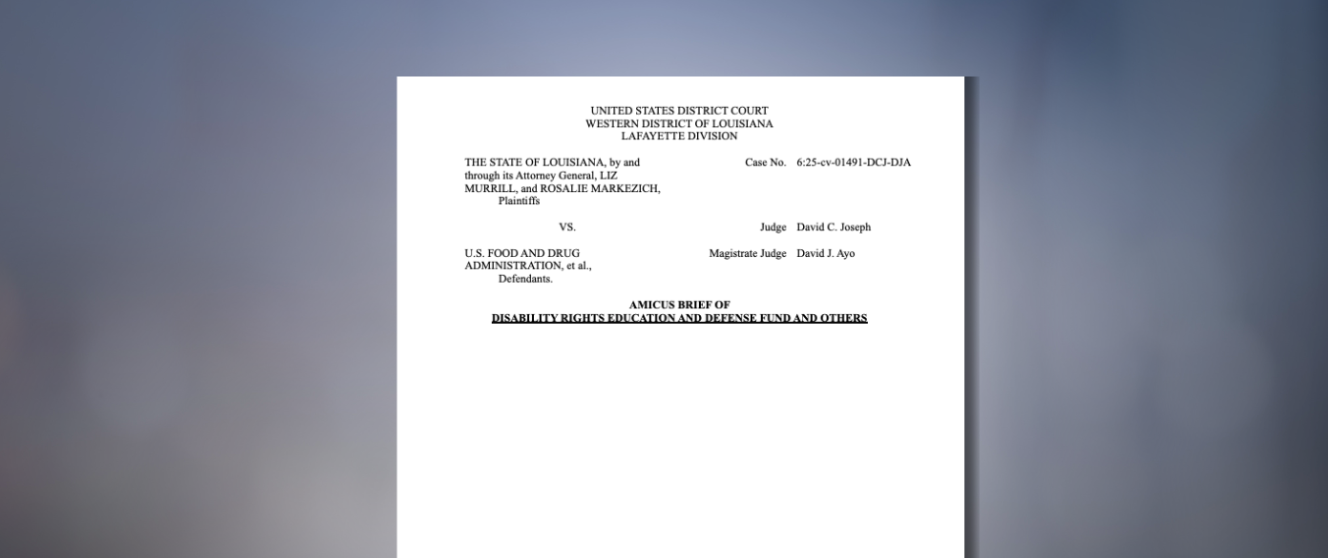
State of Louisiana v. FDA (Danco Laboratories / GenBioPro v. Louisiana) (2026)
In November 2025, the state of Louisiana sued the Food and Drug Administration (FDA) to restrict access to mifepristone, a medication used in abortion and miscarriage care. Louisiana sued to roll back the FDA’s decision to allow doctors to prescribe medication abortion via telemedicine and have it delivered to patients by mail and to local pharmacies. The Fifth Circuit Court of Appeals granted an injunction blocking access to mifepristone through telemedicine and the mail. The case was appealed to the Supreme Court. DREDF submitted amicus briefs at the District Court, Appeals Court, and Supreme Court highlighting how stripping disabled people of access to telemedicine abortion would violate Section 504 of the Rehabilitation Act and prevent disabled people from accessing necessary health care. The Supreme Court granted the request to block the Fifth Circuit’s order while the case continues in the District Court. As a result, mifepristone can still be accessed via telemedicine and the mail, but this access remains under threat as the case continues to unfold. Read more about the case here.
Moyle v. United States (2024)
In August 2022, the Department of Justice under the Biden Administration sued the State of Idaho to challenge its restrictive abortion ban. A federal law called the Emergency Medical Treatment and Labor Act (EMTALA) requires that all hospitals must provide stabilizing medical care to people experiencing medical emergencies. Idaho’s abortion ban only allows for abortions that are necessary to save the person’s life. The laws directly conflict because the Idaho ban prohibits abortion unless the pregnant person’s life is in danger, while EMTALA requires doctors to provide an abortion if it is the best treatment to stabilize a person whose health (not just their life) is in danger. The DOJ argued that the Idaho ban should be struck down because of its conflict with federal law. The case was appealed to the United States Supreme Court. DREDF submitted an amicus brief in support of the DOJ highlighting how allowing Idaho’s abortion ban to stand would put disabled pregnant people in harm’s way because pregnant disabled people are more likely to experience serious medical conditions during pregnancy and are more likely to need emergency care. In June 2024, the Supreme Court dismissed the case to continue the lower courts without issuing an opinion on the merits of the case. The Trump DOJ voluntarily dismissed the case in March 2025.
Food and Drug Administration v. Alliance for Hippocratic Medicine (2024)
In November 2022, an anti-abortion organization called the Alliance for Hippocratic Medicine sued the FDA to restrict access to mifepristone, a medication used in abortion and miscarriage care. The Alliance sued to rescind the FDA’s approval of mifepristone and roll back the FDA’s decision to allow doctors to prescribe medication abortion via telemedicine and have it delivered to patients by mail and to local pharmacies. The case was appealed to the United States Supreme Court. DREDF submitted an amicus brief highlighting how restricting access to mifepristone through telemedicine and the mail would strip disabled people of an accessible option for obtaining an abortion and lead to total denials of care. In June 2024, the Supreme Court held that the Alliance did not have standing to sue, meaning that mifepristone remains available through telehealth and pharmacies. Read more about the case here.
Zurawski v. Texas (2023)
Zurawski v. Texas was the first case filed on behalf of people denied abortion care since the Dobbs decision that stripped Americans of their constitutional right to abortion. The plaintiffs in the case were 20 women who had been denied abortion care while experiencing a medical emergency and two obstetrician-gynecologists who were prevented from providing necessary medical care under Texas’ abortion bans. The case sought to clarify the scope of the medical exceptions to Texas’ three abortion bans so doctors could provide care under the exceptions without fear of prison or revocation of their medical license. The case was appealed to the Texas Supreme Court. DREDF submitted an amicus brief in support of the plaintiffs that highlighted how uncertainty regarding the medical exceptions to Texas’ abortion bans disproportionately harms disabled pregnant people who are more likely to experience serious medical complications during pregnancy. In May 2024, the Texas Supreme Court refused to clarify the scope of the medical exceptions to Texas’ abortion bans. Read more about the case here.