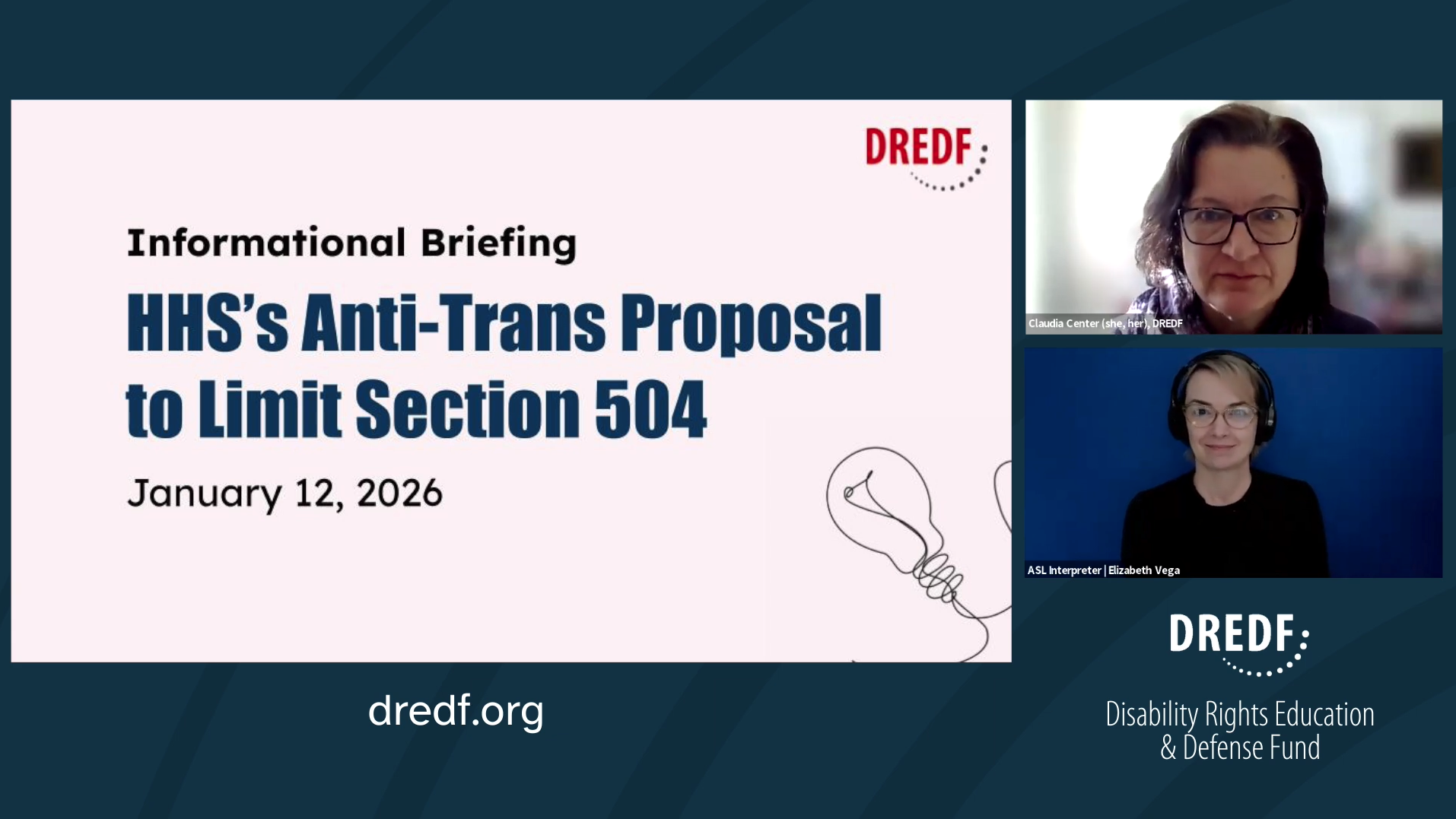

Webinar Recording
On December 18, 2025, the U.S. Department of Health and Human Services proposed three rules that will harm transgender youth and adults. One proposal is to amend Section 504 regulations to allow disability discrimination against trans people with gender dysphoria. Gender dysphoria is a medical condition experienced by some transgender individuals and that can be a disability. Section 504 bars disability discrimination by those who receive federal dollars. Learn about this harmful proposal and how you can oppose it. Comments to oppose this rule are due on January 20, 2026.
Presenters:
- Claudia Center (she/her), Legal Director, Disability Rights Education & Defense Fund
- Ma’ayan Analfi (they/them), Senior Counsel for Health Equity and Justice, National Women’s Law Center
More information:
Transcript
CLAUDIA CENTER: Hi, everyone. This is Claudia Center, I am the legal director at Disability Rights Education and Defense Fund. I use she/her pronouns. I am a White woman over 60.
I am joined today by Ma’ayan Analfi. Ma’ayan uses they/them pronouns and is the senior counsel for Health, Equity, and Justice with the National Women’s Law Center. Next slide.
I want to review our topics today. First, we’re going to review what happened on December 18, 2025, when the Department of Health and Human Services took a number of anti‑trans policy actions.
Then we’re going to provide some background information about the proposed rule to amend the Section 504 regulations.
Then we’re going to review the rule and give you a summary of what it says.
Then we’re going to review why the proposed rule is harmful and wrong.
Then we’re going to talk about how to oppose the proposed section, the proposed rule.
And, you know, sort of technically what you do; how to write up your comment and so on.
Then we’ll talk about next steps.
And then we’ll have time for questions and answers.
Next slide, please.
Okay. I’m now going to turn it over to my co‑presenter.
MA’AYAN ANALFI: Hi, everyone, this is Ma’ayan. I am a non‑binary person with light skin, short dark hair, a little bit of facial hair.
And so I’ll start by talking about what happened on December 18th.
So, on that day, HHS had a big event where they announced a whole bunch of actions as part of this concerted effort to attract trans people in a whole variety of different ways.
And so that includes three new proposed regulations.
The one that we’re focusing on today is on Section 504, the law prohibiting disability discrimination by entities that get federal funding.
And we’ll get into that in a lot more detail soon.
But basically in this rule, HHS is claiming that gender dysphoria, which is a condition that many trans people, not all trans people, but many trans people experience, that gender dysphoria can never count as a disability under Section 504.
So they’re claiming that entities that get funding from HHS are allowed to discriminate against people with gender dysphoria.
We have a super short comment period for that; it ends on January 20th, so just a week from tomorrow.
The other two rules that HHS introduced has to do with healthcare for trans youth. So this care sometimes refers to as gender affirming care or transition‑related care can be essential, even life‑saving for trans people.
And it can help trans people thrive and live the full lives that we all deserve.
And the first of these rules says that federal funding, through Medicaid and CHIP, so programs that provide health insurance for people with low incomes, cannot go towards this type of care for young people, so that would make it harder and sometimes impossible for their families to avoid essential healthcare.
And the comment period there goes on until February 17th, so we have a little bit more time there.
Can we move to the next slide? Thanks.
So, the other rule says that hospitals that participate in Medicaid and Medicare cannot provide this essential care for trans youth.
And if they do, they’re going to lose that federal funding.
And since virtually all hospitals receive Medicare or Medicaid dollars and really can’t afford to lose that funding, this rule would likely cut off trans people, trans youth, from getting this care at hospitals.
And that rule also has a comment period ending on February 17th.
And these rules are not isolated. They’re part of a concerted campaign to target trans people that this Administration has started literally from day one.
So as we noted here, so far since January 2025, there have been 77 LGBTQ actions across this Administration, including at least at least eight anti‑trans executive orders and EO rescissions.
We can move to the next slide.
Oh, yeah, I think I’m going to turn it over here to Claudia.
CLAUDIA CENTER: Hi, everyone, this is Claudia.
I’m gonna just pause here to let you know we’re going to talk about some things that the HHS officials, including Secretary R.F.K. Jr. said during the press conference and you may choose to put this on mute or look away a little bit because it’s pretty intense content. So, next slide.
So, the HHS Secretary R.F.K. Jr. said that the Biden era amendments, and by this he means Biden did ‑‑ the Biden Administration did a new set, an updated set, of Section 504 regulations, the Biden era Department of Health and Human Services that sort of updated the standards, and we’ll talk about those in a moment.
And that rule said in the introduction or preamble that gender dysphoria could be covered by Section 504, depending on the facts.
So, what R.F.K. Jr. said is that that language betrayed the original intention of the laws. That it was a misuse of the statutes. That it injures other people with disabilities, and so on.
Basically saying that ‑‑ trying to drive a wedge between the disability community and the trans community.
And, you know, just speaking for DREDF and myself, we completely reject this position taken by J.F.K. Jr. ‑‑ R.F.K. Jr.
We believe these include gender dysphoria and we believe that we should all work together to defend civil rights and not be divided.
I’m going to turn it over to my co‑presenter, and next slide.
MA’AYAN ANALFI: So, this was really just like an hour of HHS official at the highest ranks spouting a whole bunch of vial live injustifications for their actions.
And in particular, when HHS Deputy Secretary Jim O’Neill introduced this Section of the 504 rule, his starting point, the first line was recognizing transgender identity was essentially a delusional lie and he went from there and I’ll read out a quote.
And as Claudia mentioned, this is a little intense, pretty intense.
So, the denial of fundamental truths, so this is about sort of the recognition of trans people, can destroy nations from within. At the root of the evils we face, such as the blurring of the lines between sexes and radical social agendas is a hatred for nature as God designed it, as part of the Biden Administration’s war on nature, this Department’s perverted the Rehabilitation Act of 1973 and this is what they said on Section 504 and this is among a whole slew of actions that HHS took including a collaboration that R.F.K. Jr. said that this is against rights and hospitals providing this care and that is on pause now, as litigation continues. Next slide, please.
Okay, so to give you a little bit of background before we get into the proposed rule, we’re going to go over a couple of things. We’re going to go over what courts have actually said about gender dysphoria under disability and non‑discrimination laws and we’ll talk about the rule making under Section 504 under HHS, the administration, and more than a decade, what happened is including a Fourth Circuit including Williams v. Kincaid and that’s on the next slide. Can we move to that?
HHS is claiming that gender dysphoria can never be a disability under the discrimination laws and so a full 84% of courts that have considered the issue have concluded that gender dysphoria is not categorically excluded from laws like Section 504 and the ADA and actually there’s only five cases that have come out the other way.
And then in 2022, the Fourth Circuit weighed in in Williams v. Kincaid, this is the only Appellate Court ruling on the issue, and it also concluded that gender dysphoria is not categorically excluded and every decision after Williams have agreed with this conclusion.
Next slide, please.
So, as a brief summary of the Fourth Circuit’s decision in Williams, this was an ADA case brought by a transgender woman with gender dysphoria. She faced really severe mistreatment in a county jail. He was incarcerated in a men’s housing unit, she was harassed and denied medical care.
And under the ADA, like under Section 504, there is a section that says that gender identity disorders, not resulting from physical impairments, is excluded from the definition of disability.
That was an amendment that was added to the ADA just before it was enacted.
The Fourth Circuit recognized, though, that gender identity disorders, which was the diagnoses in the DSM when the ADA was passed is very different than gender dysphoria, the condition that’s recognized by the medical community today.
And they concluded that gender identity disorders does not include gender dysphoria, meaning gender dysphoria can be a disability under Section 504 and the ADA and people with gender dysphoria can be protected from discrimination under those laws.
Next slide.
So, specifically the Fourth Circuit recognized that there are dramatic differences between gender dysphoria and the now rejected diagnosis of gender identity disorders.
And as the name suggests, gender identity disorders was based on a belief that the source of the “disorder” was the person’s gender identity itself.
So essentially that being trans, in and of itself, is a disorder.
Gender dysphoria reflects a really, really different understanding of this experience.
The focus of gender dysphoria is the clinically significant distress that someone may experience, not trans identity.
So you don’t have gender dysphoria simply by virtue of being trans, you have gender dysphoria if you experience a distress and other disabling symptoms.
And the Fourth Circuit that said that these conditions reflect such a different understanding of these experiences and gender dysphoria understood when it was passed in 1990 does not encompass gender dysphoria.
Part of what informed the Fourth Circuit’s decision was that Congress had been very clear that disability needs to be read broadly.
And when Congress amended the ADA in 2008, it expressly directed to courts to construe disability to the maximum extent permitted by law.
And since the law, you know, at minimum permitted gender dysphoria to be included as a disability, courts needed to interpret it that way to stay true to Congress’s intent.
And then another consideration for the First Circuit was that there was a lot of evidence that when that language on gender identities disorders was added to the ADA was based on clear anti‑trans prejudice, there was no legitimate basis for Congress to exclude gender identity disorders.
The evidence shows it was primarily driven by animus and to harm transgender people and that can never be a constitutionally sound basis for a law.
So the Fourth Circuit concluded that applying that language to gender dysphoria would raise serious constitutional concerns and in order to read the ADA similar to Section 504 in a constitutional way, that gender identity disorder needed to be concluded and not from gender dysphoria. Next slide, please.
Yeah, I think I’m turning it over to Claudia here.
CLAUDIA CENTER: Yes, back to Claudia here. So I want to talk about HHS’s Section 504 rule from May of 2024. This was an update of the Section 504 regulations that had not been updated in many years.
And there was a discussion of gender dysphoria and the Williams case not in the regulation itself but in the preamble to the final rules and not in the rule itself.
And in that preamble to the May 2024 final rule, HHS reviewed the Williams case, reviewed gender dysphoria, and said that it agreed with Williams, that gender dysphoria may be a disability under Section 504, depending on the facts.
So, that is what happened with the Biden Administration. And what the speakers at the press conference were talking about, as using all of that horrific language filled with animus.
Next slide. I think I’m gonna turn this over to Ma’ayan.
MA’AYAN ANALFI: Hi, this is Ma’ayan again. So, I will provide a brief summary of the proposed rule that HHS put out on December ‑‑ in late December.
So, the proposed rule, essentially, is claiming that gender dysphoria can never be a disability under Section 504. So it’s trying to categorically exclude gender dysphoria that applies to HHS respondents.
And the proposed rule is telling entities that get HHS funding that they can freely discriminate against people with gender dysphoria and as we discussed, that is not what the law says and not what the vast majority of courts have said, and so HHS is wrong about that.
And if HHS funding recipients discriminate against people with gender dysphoria, they are, in fact, violating Section 504. Next slide.
So, to be more specific, the rule is changing the definition of “disability” in HHS’s regulations on Section 504.
So, it would say that gender identity disorders includes gender dysphoria, the language is specifically, the term gender identity disorders not resulting from physical impairments includes gender dysphoria not resulting from physical impairments. Next slide, please.
So, we’re going to talk a little bit about why this rule is harmful and wrong.
So, as I mentioned, this rule is wrong on the law, no matter what HHS said, federally‑funded entities still need to follow Section 504, including the protections it offers for people with gender dysphoria, but if the proposed rule is finalized, it can lead many of those entities to think that they can discriminate.
And that would cause some immense harms for people with gender dysphoria.
So, they can be turned away from basic Health and Human Services, denied care or benefits, face mistreatment, harassment, all sorts of things.
And that can include, you know, anything from being turned away from seeking medical care and even if the care they’re seeking is not related to gender dysphoria.
This includes a lot of human services, as well as health settings, so it can include things like facing discrimination in child welfare settings, like in foster care or being excluded from really vital programs for family with low incomes, like nutrition assistance and programs like Head Start which is a school readiness program, in heating and cooling assistance, and all sorts of things like that.
So this can have really, really wide‑range ramifications.
And we know that people with gender dysphoria already face really, really high rates of discrimination in these settings, already face really significant barriers to getting these services.
And this rule would make it even worse. Next slide.
So, the evidence also suggests that what’s at least partly motivating, if not more of this rule, is anti‑trans bias. So since day one, this Administration has made anti‑trans attacks one of the centerpiece efforts of its agenda.
So, it’s part of a coordinated effort, spanning across the Federal Government, and they’ve made very, very little efforts to hide that ‑‑ these attacks are rooted in prejudice.
And HHS has explicitly relied on that kind of prejudice to justify this particular proposed rule.
We saw that in some of the quotes we shared earlier, the way that the Deputy Secretary tried to justify this rule by saying ‑‑ by using sort of inflammatory and horrific language about trans people.
And that kind of animus can never be a basis for rule‑making.
Next slide.
I’ll turn it over to Claudia here.
CLAUDIA CENTER: Thanks, Ma’ayan.
This is Claudia. And I wanted to add that throughout the press conference, you can also see that the officials are also drawing on ableism as well, wasn’t trans bias and ableism are often intertwined, and there’s a belief that young people or adults who are transgender who may also have co‑occurring conditions, like autism or ADHD, that people with those disabilities cannot know their own gender identity; cannot make decisions about their lives.
That they have diminished capacity in some way to make those foundational decisions about how to live their life and medical care.
And so, you know, the bias that our communities face are ‑‑ the biases are intertwined.
The proposed rule violates the ADA Amendments Act which was enacted in 2008, and that statute explicitly states that courts and agencies, like HHS, should construe the definition as broadly as possible under the terms of the ADA.
And then that ADA definition is then incorporated by a reference into Section 504. So it’s all the same definition of “disability.”
So that’s what the ADA Amendments Act directs explicitly.
But then the proposed rule, instead of that direction, narrows the definition of “disability” by excluding gender dysphoria categorically. Next slide.
And I’ll just reiterate that Secretary Kennedy is wrong, including people with disabilities based on gender dysphoria in the protections of Section 504 does not harm people with other disabilities.
People with all different kinds of disabilities are stronger when we work together and resist efforts to divide us or to weaken civil rights.
So, we do not agree with Secretary Kennedy’s position. And it is very important for the disability community to show up and submit comments in opposition to this with divide and conquer approach that is harmful. Next slide.
I’m going to turn it over to Ma’ayan now.
MA’AYAN ANALFI: Hi, this is Ma’ayan again.
So, another reason why the HHS proposed rule fails is that as we mentioned, they are wrong on the law.
So, as the overwhelming body of case laws against that gender identity disorder is not with gender dysphoria and it is not excluded from protections and that was mentioned in the case mentioned earlier, Williams v. Kincaid, where the Fourth Circuit carefully considered the question and ruled that people with gender dysphoria can be covered.
And HHS disorders this overwhelming body of case law and really does end sort of properly address the reasoning that these cases are based on. Next slide.
So, one other concern, sort of one other reason why this rule would fail is that Section 504 needs to be interpreted in a way that is consistent with the Constitution.
So we mentioned also earlier that the Fourth Circuit said if we read the law to exclude gender dysphoria, that’s going to raise serious constitutional problems and questions because of all of that evidence that the gender identity disorders exclusion was motivated by discriminatory animus and not any legitimate purpose.
And the proposed rule ignores that, and instead offers an interpretation of Section 504 that would raise all of those constitutional questions and would present an interpretation of Section 504 that may not be consistent with the Constitution.
Next slide.
I’ll pass it back to Claudia.
CLAUDIA CENTER: Thanks, Ma’ayan.
This is Claudia.
So, now we’re going to talk about how to oppose the proposed Section 504 rule that limits the definition of “disability.”
So basically there are two steps. The first step is to write your comment.
And the second step is to submit your comment through the Federal Register web portal or you can also send your comment in by mail, traditional mail.
Comments must be postmarked or electronically submitted by January 20, 2026. So this is a really short comment period.
And we are urging people to submit opposition comments to make our voices heard, even though there is a short time period. Next slide.
So, we’re going to review what to include in your comment.
So, the first thing to do is to introduce yourself. If you are not submitting your comment anonymously, you can introduce yourself by name.
We think it is good for you to state your connection to Disability Rights and Section 504.
You can include things like your profession or your personal experiences.
But you should also consider your safety and privacy. These comments are going to be published, whether or not they’re anonymous, and so you need to weigh how much you choose to share.
Then the next thing is we want the comments to include the opposition to the proposed rule, and the comment should state that you do not want who have a disability based on gender dysphoria to be excluded from Section 504’s protections.
So, that’s sort of the second thing you should include in your comment.
Next, you should explain why you oppose the rule.
So, you can use our materials, DREDF’s materials, either our web posts or this slide deck that will go out to all of you.
We also have some materials on social media.
So you can use those DREDF materials to come up with ideas for what to say.
And we really do urge people to use your own words.
We understand that the Administration uses software or AI to check whether comments are repetitive, like everyone using the same template.
So, we urge you to use your own words to submit a unique comment opposing the proposed rule. Next slide.
We also want everyone to ask that the comment period be extended. 30 days is way too short for an issue of this importance.
The other two rules have the standard 60‑day comment period.
We’ll also note that the 30 days overlapped with holiday and end‑of‑year break.
We found that the rule‑making portal was incorrectly closed for several days. Advocates had to reach out to HHS to get them to fix the portal.
The comment period should be extended for another 30 days. And you should conclude by restating your opposition to the proposed rules. Next slide.
I’m going to pause for a minute. Ma’ayan, do you want to say anything about the comments we had talked a little bit before about weighing, you know, including your personal experiences, but also thinking about your comfort level? And I wondered if you might want to speak to that?
MA’AYAN ANALFI: Sure. So, I’ll just underscore what Claudia mentioned before, about, you know, what you say in these comments is going to be accessible both to the public and to the Government itself, and so those ‑‑ not only for the 504 rule but particularly for the rules on the gender affirming care we mentioned earlier.
You may want to be intentional about what information you share, particularly if you’re sharing personal experiences as a trans person, especially as a trans young person, or as a family member of a trans person or someone who provides healthcare or other services to trans people.
And we know this Administration is being aggressive in a number of ways, particularly against health providers and others who support trans youth.
And that might impact how specific you want to get about your own experiences or how much identifiable information you want to provide about yourself or the trans people you work with, even if you are submitting anonymously.
And I don’t say that to discourage anyone from commenting, but it’s just a really important consideration, as you decide what to say, as you decide how to weigh your risk, as you decide how to protect the trans people you serve or your family members or yourself.
And also if you have, like, sort of specific questions about your situation, you can also feel free to contact me and I can either help answer or connect you with others who can.
CLAUDIA CENTER: Thank you, Ma’ayan.
So now we’re going to go through technically how to file your comment through the regulations.gov federal portal. Prior slide, please.
So, we have the link in the slides as a hyperlink and also typed out for how to directly go to the comment portal for this rule‑making.
So, you can see a picture of what pops up, if you click on that link or type in the URL that we’ve provided. It will go to the ‑‑ directly to the comment page for this rule‑making. Next slide.
And the alternative route you can go to regulations.gov and type the rule making title and the title is HHS‑OCR‑2026‑0034‑0001.
And so if you go to that alternative route, you can see a picture on this slide of what that looks like; it basically shows the results of your search and it shows the non‑discrimination on the basis of disability rule that we have been talking about throughout this webinar. Next slide.
Okay. So, click on the blue “comment” button, if you’ve gone through that alternative path to get to the comment portal. Next slide.
Okay. So now that you’re in the comment portal for this rule‑making, you can actually just type or paste your comment right in this comment field, which you can see in the picture we’ve included here, where it says “write a comment” and then it says “comment” with a red asterisk and you can type your comment in that comment field if it fits.
Your comment must be less than 5,000 characters, about 800 to 1000 words and you can type that in there.
And if you have a longer comment, you can say “see attached” or I am attaching my comments and that’s what that red asterisk means in that field. Next slide.
You can also attach your comment to a document, you can use Word or a PDF file, and so you can see in this picture, you can attach files by dragging a file into the box or by browsing your computer and uploading your Word or a PDF file.
And again, you would write in the comment field above the attached files section, you would type something like “Attaching my comment or file attached” or something like that, because you do have to enter something in that field.
And remember, you don’t scan your Word document to make a PDF. The PDF, you would create on your computer, so it’s a readable PDF. Next slide.
Okay. So then if you go down the ‑‑ scroll down in the comment portal, you will see a place to enter your e‑mail address, if you choose to provide it.
You can leave it out if you want to remain anonymous.
You can also select the check box to receive e‑mail confirmation of your submission, and a tracking number, but that’s not required. Next slide.
You then, as you scroll down, will see an option to select whether you’re an individual or an organization or whether you want to submit your comment anonymously.
And as we have emphasized, all comments are made available to the public, even if you select anonymous. So we’ve emphasized that throughout. Next slide.
So then toward the end of the comment portal, you will select the box that says “I am not a robot.” You will review your comment, make sure you’re good with it, and then you click on the blue “submit comment” button, and that’s it. That’s all you have to do.
It may seem daunting, but it’s pretty self‑explanatory once you get to the right place. Next slide.
You can also file your comment by mail, and some people prefer to file their comments by mail. It actually requires the agency to do a little bit more work, because they have to open the envelopes, they have to review the paper inside, they have to scan it, and put it up on the website, and it takes a few more steps.
So, if you want to send your comment by traditional mail, it must be post‑marked by January 20, 2026, and addressed to the U.S. Department of Health and Human Services, Office of Civil Rights, Attention: Disability NPRM, RIN 0945‑AA27, Hubert H. Humphrey Building, Room 509F, 200 Independence Avenue Southwest, Washington, D.C., 20201.
And many of us have heard recently about a new rule by the United States Post Office that explains how they add postmarks to mail. That was news to some of us; definitely news to me. And what the new rule explains is that postmarks are not necessarily added to your mail on the same day as mail is collected by your letter carrier or dropped off in a box or at the post office.
So, to be sure that your snail‑mail comment is postmarked in a timely way, you can mail your comment before January 20th, maybe two or three days before, or you can go into the post office and go to the counter and ask that it be manually postmarked, and that is a service that USPS will offer you at the counter. Next slide.
Okay. So I’m going to turn this over to Ma’ayan about next steps. Thank you.
MA’AYAN ANALFI: Sure. So, as Claudia mentioned, we want to make sure to get as many comments as possible on the Section 504 rule by January 20th.
And we encourage folks to also comment on the other two rule makings we mentioned, so the two rules that target healthcare for trans youth, and those have that deadline of February 17th. This one is 5:00 p.m., so Eastern Time, so just make sure to get it before then.
And then there’s a few things you can do to comments. You can comment through the regulations.gov website that Claudia walked through.
And if you want some more guidance on how to do that, The Center for American Progress has a public toolkit that’s linked in our slides and they provide some general guidance on how to submit comments on these rules targeting care for trans youth.
You can also directly submit through a portal that our friends at the Human Rights Campaign have put together. So, for individuals, you know, you want to share sort of, you know, their perspectives or experiences and particularly if you want sort of that extra layer between you and, you know, submitting directly on regulations.gov, you can use that HRC portal.
And if you don’t have time to do either of those, another option as a backup is to also sign a petition that the ACLU has put together.
And that’s for individuals who want to speak out against the rules and that would be submitted as a comment as well.
Yeah, I think we’re done with this slide.
CLAUDIA CENTER: Okay. We’re now at questions and answers.
I think we can, for now, take the slides down and so Ma’ayan and I can both be visible.
And we’ll start with questions that we have in our question box.
The first question is: Can the Section 504 rules or the Amendment be undone with a positive legislation?
And I think the answer to that is, as a technical matter, yes. Congress could amend Section 504 and the ADA to reject a rule that limits the definition of “disability” and say, one more time, you know, we don’t want you to limit the definition of “disability” and we reject this rule.
I would say that that is very difficult to achieve. It’s always been very difficult and it’s even more difficult now, when Congress is not functioning at all or very well.
So, just to give an example, the cases that the ADA Amendments Act rejected were decided in 1999 and 2001, and it took till 2008 for Congress to reject those cases and to adopt legislation that clarified and essentially expanded the definition of “disability” opposing those agency and court rulings.
And so that means that for, you know, nine years, and even longer, because there were lower court decisions that were terrible, people went without the protections of federal non‑discrimination law.
So it just really takes a very long time for legislation to happen.
State legislation can be quicker. For example, California got rid of a lot of these negative federal exclusions way back in 2000, so State Legislatures can act quickly.
Of course state law does not necessarily apply to recipients of federal financial assistance; it would depend on the facts. So that doesn’t necessarily protect you.
Ma’ayan, do you want to talk about this Congress and positive law?
MA’AYAN ANALFI: No, I think that’s it. Like, there are some other levers that Congress can review. There is a congressional act that goes against their intent, they do not agree with it, but that needs to be sort of ‑‑ that needs to happen quickly and in addition to Congress sort of not functioning, then that would also need ‑‑ they would need to be able to override a veto, which is not something that realistic at the moment.
CLAUDIA CENTER: Okay. Our next slide (sic) says does this mean that this rule would allow nursing homes and rehab facilities to discriminate against trans and disabled people?
MA’AYAN ANALFI: I can start with this one.
So, I guess it’s a very lawyerly “maybe” and that’s for a couple of reasons. So, one, as we mentioned, no matter what the rule says, the statute, the protections that are guaranteed by the statute still apply.
So, if sort of a nursing home or another care facility that gets HHS funding discriminates, they might still be liable, there might still be sort of an opportunity to enforce it through a lawsuit or something like that, even if HHS itself is not enforcing it.
It might, though, encourage them to do so, and obviously there are huge barriers to moving through a lawsuit and things like that.
And entities that want to discriminate ‑‑ sorry, I have a cat that wants to join in ‑‑ that wants to discriminate might use the HHS rule as a way of supporting ‑‑ sorry! ‑‑ of supporting their position.
And the other thing to consider is that there are other federal non‑discrimination laws that would likely apply to at least some healthcare settings.
So that includes Section 1557 of the ACA which prohibits discrimination against sort of ‑‑ based on a range of protected characteristics, including disability, including sex.
Under previous Administrations, it was clarified that the prohibition of discrimination based on sex includes discrimination against trans people or discrimination based on gender identity.
And we still believe that that is the correct reading of Section 1557.
But there has been litigation around that and the Trump Administration has taken their own position, saying that that gender identity is not covered by Section 1557 ‑‑ oh, it’s been years every time! ‑‑ Section 1557.
And so how likely it is that it would be enforced is sort of also sort of up in the air.
CLAUDIA CENTER: Thanks, Ma’ayan. The next question is: Do state disability discrimination protections draw from the Federal Rehabilitation Act and ADA disability definitions and exclusions? Are there state implications for this proposed 504 change and/or can states legislate to mitigate harm if this goes through?
Good question. A lot of discrimination laws, non‑discrimination based on disability laws, when they were enacted tracked Section 504 and the ADA. That was very common for the ‑‑ for a certain generation of state disability non‑discrimination laws.
And what happened was when the ADA definition and 504 definition began being shrunk in the 1990’s and 2000’s, some states went back and amended their state laws to say, oh, no, no, we don’t mean this.
We actually believe in a broad definition of disability.
And as I mentioned earlier, that’s what California did in 2000. And in 2000, we actually took out, we had previously incorporated by reference the exclusions from the ADA and, instead, in 2000, California dropped that “gender identity disorder” exclusion from our state statute.
So it is absolutely appropriate and feasible for states that have Legislatures which support people with gender dysphoria and trans people, to amend state laws to include trans non‑discrimination and to make clear that the disability state law does not include the federal exclusion language.
Anything else on this, Ma’ayan?
MA’AYAN ANALFI: Yeah, I’ll just add that there are a bunch of state disability and non‑discrimination laws that do sort of specifically and explicitly protect against discrimination based on gender dysphoria, some is through case law and some through statute.
So we do have sort of a template for future states to do similar things as well.
CLAUDIA CENTER: And I think that is, like, a really positive thing to think about right now, what people can do at their state levels, state level, to support disabled people and trans people.
A reminder from Rosemary about the postmark issue from USPS. We did review that.
Here’s a question that maybe Ma’ayan will answer: If you don’t feel comfortable using your name and sharing identifiable information, what can you do to oppose the rule? How can you submit anonymously?
MA’AYAN ANALFI: So, in terms of ‑‑ I guess in terms of, first, like the technical matter, I think in one of the slides Claudia went through, she showed sort of where you click on to submit anonymously.
But then, of course, as I mentioned, even if you’re submitting anonymously, if you have sufficiently identifying information, there is a small chance that that can be sort of identified.
That’s probably not going to happen with individuals. That may be a little bit more of a concern for, say, healthcare providers or something like that.
So, if a healthcare provider is talking about how they are, you know, protecting trans youth from discrimination or how they’re specific or gender affirming care and how they’re providing gender affirming care to trans young people, they might consider, you know, are they providing sort of specific information about their location and their experience?
And sort of the types of patients that they have that might be able to identify them.
But I think generally, if you’re submitting anonymously, then I think you can sort of choose what information you feel most comfortable sharing, just keeping in mind that it will be public.
CLAUDIA CENTER: Our next question is: Can you talk more about the constitutional questions that rejecting gender dysphoria from this might propose? I’ll answer this and pass it to Ma’ayan.
So there’s this idea that we thought that was well established is it’s not constitutional for the Federal Government to enact laws based on a bare desire to harm a minority group.
So, there are different groups that historically only had “rational basis.” All of us who are lawyers remember this from law school.
So, in other words, laws can be passed by any branch of government, as long as there’s a rational basis to uphold the law, which is a very broad standard. Most laws get upheld.
However, if there is a bare desire to harm a group, a minority group, and that’s the animating force behind the law, then that is not considered rational basis, that is an impermissible constitutional basis for lawmaking.
And so if you look at, you know, what happened in 1989 and 1990 with the ADA and the hearings that added the exclusions, and then you look at 2025 and the anti‑trans agenda, including the press conference that released this rule, you really end up at a place where this is a bare desire to harm a group of people and that that’s not a legitimate basis for limiting a non‑discrimination statute. But Ma’ayan, I’ll pass to you.
MA’AYAN ANALFI: I think you covered everything.
CLAUDIA CENTER: Okay. Next one I’m going to read out loud and then I’m going to see if Ma’ayan wants to answer.
The question is: How vulnerable do you think Williams versus Kincaid and the others is, if this proposed rule is finalized? Do you think this will leverage this rule will overturn?
MA’AYAN ANALFI: Claudia, I would be interested in your thoughts as well, but the case law exists independently of the rule itself, so it’s an interpretation of the statute.
Now, HHS’s interpretation can ‑‑ might be used by some litigants as sort of a consideration to point to, you know, the Federal Government has interpreted this way.
We also know that in the past, DOJ, the Department of Justice, has filed statements of interest in cases, saying, you know, under previous Administrations saying that gender dysphoria is not excluded and that can be ‑‑ that can be persuasive in and of itself.
And we do not expect now DOJ to be doing that, we would expect them to be going the other way in statements of interest.
So that, I think, along with the rule can impact litigation going forward.
I think, though, there is still a good chance of both courts rejecting HHS’s position and saying ‑‑ just looking at the statute, gender identity ‑‑ sorry, gender dysphoria is not excluded.
CLAUDIA CENTER: And this is Claudia, and from a practical or maybe strategic is a better word, I think that cases that involve real individuals with real stories and real harms who are bringing claims that might include disability discrimination based on gender dysphoria, that those are stronger ways to bring the claim that gender dysphoria is included as a possible disability, depending on the facts.
I think that when it’s divided from real people with real stories, it can be harder or less persuasive.
Next question: What does the Administration and HHS, how do they benefit in terms of separating disability and gender dysphoria? Is it just to ensure a conservative agenda? Or is it more than that?
MA’AYAN ANALFI: I can start. So, I think this is sort of their way of kind of appropriating the disability community and trying to use that to undermine the rights of people with gender dysphoria.
As Claudia mentioned earlier, they’re trying to kind of pit these communities against each other and then try to peel away support for people with gender dysphoria, because they perceive the disability community might feel like somehow the inclusion of gender dysphoria in Section 504 undermines the statute and undermines their rights.
And, of course, there’s no basis for HHS to be claiming that somehow recognizing gender dysphoria was a potential disability hurts the statute or hurts anyone or any other people with any other disabilities in any way.
And so I think this, yeah, this is more of like a strategic way of them trying to isolate trans people and to try to use the language of civil rights to justify their position, which is something that we’ve seen this Administration do a lot, including against ‑‑ in their attacks against trans people, too, to weaponize civil rights language and statutes to further inequality.
CLAUDIA CENTER: The next question is: Since we have limited time to submit our comments, when will we receive your slides to help guide us?
I believe the slides will go out today. And let me pause for a moment to see if Ally or Drew can confirm. Yes, they should be going out today.
CLAUDIA CENTER: Can I ask about this Administration and the anti‑trans laws that have been passed? In the capacity as mentioned earlier so I have reviewed at times the legislative history behind some of the anti‑trans laws that have been passed in different states.
And also some of the federal content.
And if you look at that, those legislative histories or the rule‑making history, you see a lot of content that is not only a demonstration of anti‑trans bias, but also ableism.
You see lawmakers and officials, like these HHS officials, talking about other disabilities that trans people might have, such as autism or ADHD or some other conditions that are separate disabilities and that for whatever reason, and we don’t know, I mean, we have some ideas, but for ‑‑ that tend to be higher among trans people.
And so what these lawmakers and officials say is oh, these people with disabilities, like autism or ADHD, they really don’t know their gender identity disorder.
They are just struggling with symptoms of these other abilities and you can’t trust people with these other disabilities to know and their gender identity or to make decisions. Ma’ayan, anything further?
MA’AYAN ANALFI: Yeah, so we definitely saw HHS officials relying directly on this talking point, or maybe I should say indirectly here, but they definitely cited the sort of instances of disability among people with gender dysphoria, among trans people more generally, as a justification.
And I’ll just emphasize that this kind of framing is not only an attack on trans people, it’s an attack on the disability community more broadly.
Because it further this narrative that if someone has a disability, they cannot understand their needs, they cannot make decisions about their bodies; that they are ‑‑ that their own decision‑making capacity should be treated with suspicion on even undermined.
And so I think this goes to show ‑‑ it goes to further underscore the point that Claudia made earlier in the presentation about how ableism and anti‑trans bias has been really, really intertwined.
CLAUDIA CENTER: The next question: Are there national trans or LGBTQ+ orgs sharing information about this rule? This would be a great opportunity for cross‑movements solidarity.
MA’AYAN ANALFI: Yeah, I think one of the things that we’ve seen out of this rule is a lot of that ‑‑ a lot of that cross‑movement solidarity, growing even more than it was before and trans‑led groups and other groups being actively engaged around this proposed rule.
And I think that as well as sort of other groups focusing on civil rights and health and things like that.
And I think that coalition is really powerful, because it goes against HHS’s attempts to sort of pit communities against each other and to isolate trans people.
And it shows that we have sort of a unified opposition to the attack on trans people and to the kind of rhetoric that HHS is using.
CLAUDIA CENTER: Okay. The next question: In our comments, should we refer to the apparent strategy of the Administration using disability rights law to discriminate against trans people? Or is that saying the quiet part out loud? Thoughts on that, Ma’ayan?
MA’AYAN ANALFI: Yeah, I think it is something that is really important to call out and make clear.
I think particularly, you know, responding to this idea that cutting out gender dysphoria or that recognizing gender dysphoria as a disability undermines Section 504.
We should be responding to that directly and particularly folks who have experience and expertise within the disability community around these laws sort of coming out and saying, you know, like, you cannot use these laws to try to ‑‑ to try to harm a group that, you know, you’re trying to attack or that you disfavor.
CLAUDIA CENTER: Next, and I believe last question: Is there any relief or sanctuary in places like IDD or Lanterman, and I believe those refer to California programs and laws, for pushing back?
So, you know, California, like each state, has an independent set of laws and approaches to things like disability rights and gender and trans people.
So, in California, our non‑discrimination laws cover gender identity, so they cover trans people directly.
We don’t have an exclusion for any gender dysphoria or other diagnoses in our disability rights laws.
Our services and supports for people with intellectual and developmental disabilities are theoretically supposed to support the individuals with the disability and they have an offer for conservatorship and people with intellectual and mental disabilities do have some resources and tools in California around gender identity and trans status that can be helpful.
That does not mean that, you know, culturally every regional center or, you know, every service provider for people with IDD is completely accepting of trans people or, you know, people who are trans and disabled.
You know, we have a lot of work to do [coughing] on all these issues, and, you know, it’s always a process that’s sort of ongoing.
I think that’s ‑‑ we’ve now gone through all the questions.
CLAUDIA CENTER: I would like to thank everybody for attending our session. We had a good group of people.
And if you all file comments against these rules and if you get some of your friends and colleagues and constituents and co‑workers and, you know, if you work with a disability or a community group or a trans rights group or LGBTQ+ group, I mean, we just really want there to be a lot of comments opposing this rule.
Just since, you know, because the remarks and the rhetoric are just so terrible, we want to stand up and say, look, you are not dividing us, we are together in opposition to this rule.
We would like to thank our ASL interpreters and our professional captioner who joined us today.
I would like to thank all of my colleagues, not just Ma’ayan, but some other people who reviewed our materials and slides over the past few days.
We would like to remind everyone to include our evaluation, which Drew has shared in the chat.
And I’ll pause for a moment, but I believe we have concluded this webinar. We will make it available in video form shortly later this week.
And we will circulate it so that people can have it to use for comments to be submitted by January 20th. Thank you.
[End of Transcript]