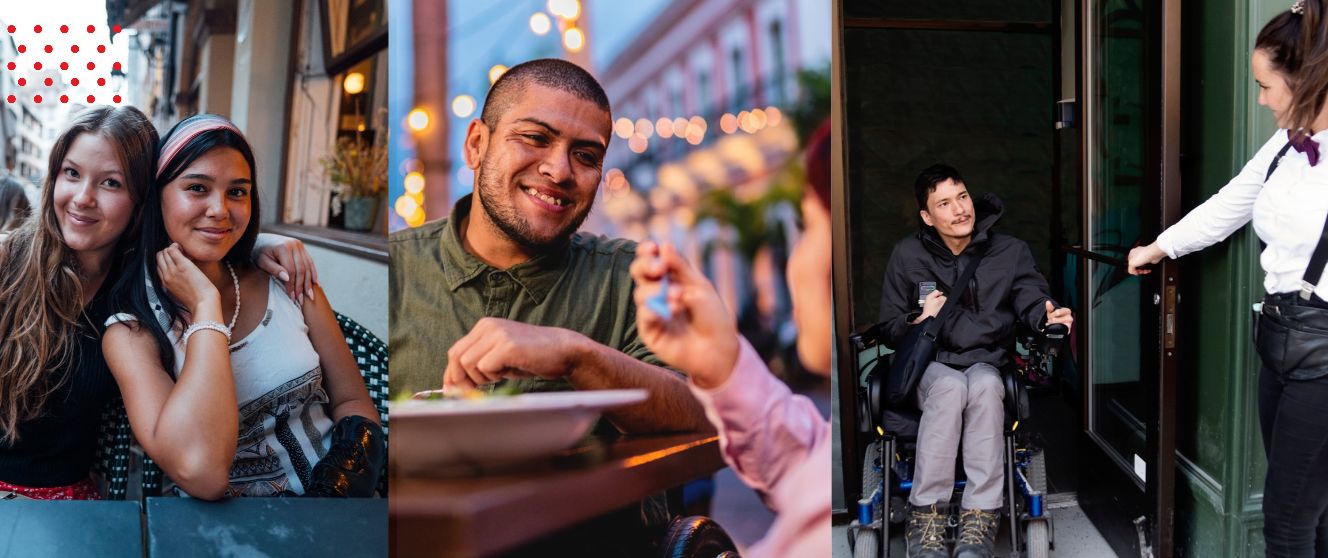

Earlier this month, on October 10, the first national “Disability Night Out” was launched, urging disabled people to dine out and reclaim public space while also informally verifying accessible spaces that should exist after decades of disability rights laws and advocacy. As an attorney at DREDF, and someone who first got her introduction to disability rights laws at the feet of Theresia Degener, a disabled lawyer and international law expert from Germany, Disability Night Out immediately reminded me of an important case from Germany.
The 1980 case is known as the Frankfurt Judgement among disability scholars. It involved a 64-yr old woman from Germany who stayed at a hotel facility in Mallorca as part of a vacation package. Twenty-five people with mental health disabilities and their care assistants were also staying at the same hotel. Everyone shared the same dining facility. After returning to Germany, the woman sued her travel agent, claiming that her vacation was partially ruined because she had to eat in the same space as disabled people whose appearance and ways of interacting caused her to feel ‘nausea’ and were disruptive to her appetite and peace. The court agreed and awarded her a 50% refund of her travel expenses for that part of the stay.
The court’s understanding of disabled people as mere ‘travel disruptions’ that could justify damages catalyzed a German disability rights movement and highlighted how disabled people endured inaccessibility, discrimination, and segregation in the country. People with disabilities in Germany spoke out for themselves, organized public demonstrations, and made the national news for the first time as citizens fighting for their own rights.
Many of us would like to think that in 2026, disabled people in the US live in completely different circumstances than disabled people in 1980s Germany. We have fought hard for laws that protect us from discrimination. We have accessible public transportation, education, and healthcare. There are established ways to apply for and receive needed services and supports for education, employment, and community integration. And yet, more similarities in our situations remain than we might wish.
Our current federal administration has spent two years cutting Social Security, Medicaid, and special education services. They have undermined the vaccinations that make it possible for immune-compromised disabled people to attend school and be in the community. They are redistributing research and census dollars away from identifying people with disabilities and obscuring the impact of how changes in funding and services are impacting the life and health of disabled people and their families. And they have persistently downgraded civil rights enforcement of the rights of disabled people across the full diversity of our identity, pulling back on enforcement even on our core right to be fully integrated in our own homes and communities. While people with disabilities in the US today have many advantages over the disabled people who organized in Germany after the Frankfurt decision, we must still confront and care about the barriers that remain.
There are disabled people who don’t get nights out because they live in an institution with locked doors. There are disabled people who don’t have enough support services or appropriate devices to leave their homes, who haven’t had the opportunity to learn at school with their peers, get a fair shot at a job, or build up enough economic means to enjoy a meal out. The fundamental lesson of the Frankfurt Judgment is that our larger society mistakenly wants to treat disability as a limited and quantifiable problem that can be “fixed” by taking care of a few, rather than recognize that disability is a fact of life for everyone and the appropriate response is to commit to recognizing the human dignity and equal worth of all.
In the end, Disability Night Out isn’t only about having good food at a nice place or showing that disabled people can be economically and socially successful, though it’s important to celebrate our progress as well as treat ourselves when we can and however we can. A disabled person dining at Chez Panisse and a disabled person sharing fries with a friend at McDonald’s equally belong in the world. Disability Night Out reminds us that ableism is tenacious and pernicious. It will remain even if we eventually get to a fully accessible world with implemented civil rights, greater income equality, and corporate and government accountability. The only way to resist ableism is to insist on our full right to be in society as we are. Lawyers can fight to embed our rights in law, but only disabled people ourselves can live fully embedded in our society.

About the author
Silvia Yee is the Public Policy Director at DREDF, where she advances disability rights through health care policy, accessibility initiatives, and civil rights advocacy. Her work focuses on health care as a civil right, community integration, international disability rights, and the intersection of disability with race, LGBTQ+ identity, age, and income.