
FOR IMMEDIATE RELEASE:
April 15, 2026
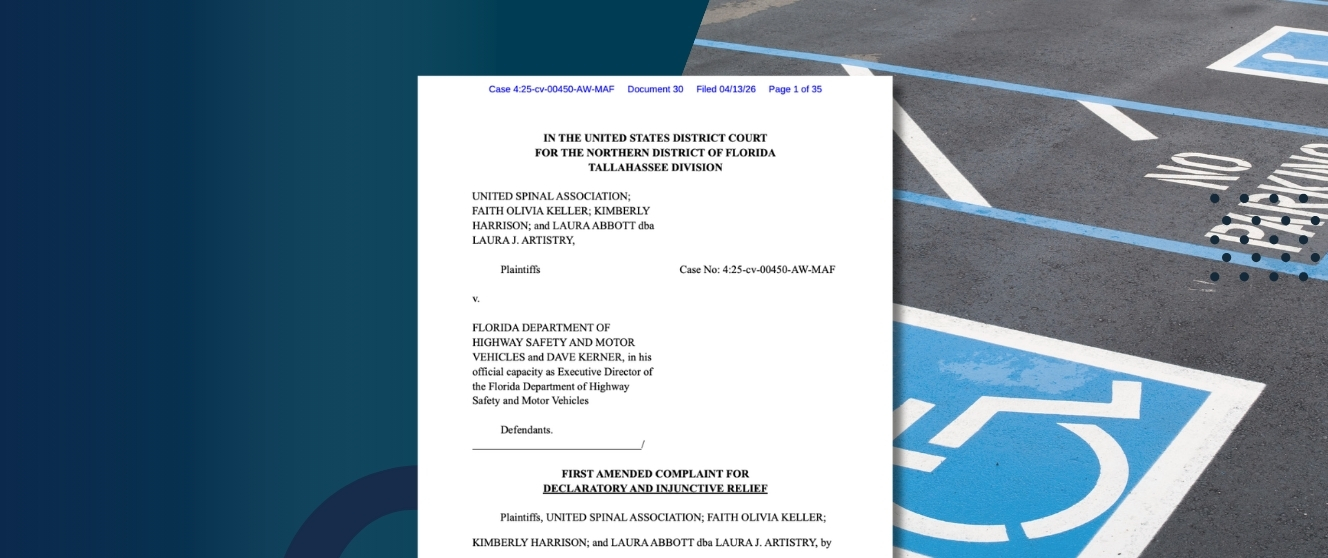
TALAHASSEE, Fla. – Yesterday, United Spinal Association and others filed a complaint in the Northern District of Florida federal court challenging a Florida law which lets anyone who is pregnant get an Expectant Mother Parking Permit and park in disability parking spaces.
Under the new Florida law, the only requirement to receive a pregnancy parking permit is pregnancy. The applicant does not need to show any mobility impairment or other disability. As a result, thousands of Floridians without disabilities are parking in accessible spaces that, under federal law, are reserved for people with disabilities. The complaint alleges that this violates the Americans with Disabilities Act (ADA), which trumps state law.
People with disabilities already have a hard time finding accessible parking. “Every time we go out, we have to leave early for events or appointments,” said Kimberly Harrison, a plaintiff in the case, “Spots fill up fast.”
Now disabled Floridians like Ms. Harrison have even more trouble parking. Recently, Ms. Harrison had to exit her vehicle and transfer into her wheelchair in the driving lane because the accessible parking spot she needed was already taken by a woman with a pregnancy permit. She was no longer pregnant and had her baby in the car. “The pregnancy permits last a year,” Ms. Harrison explained.
“Most people with disabilities have difficulty finding accessible parking spaces in their communities – and many skip medical, professional, and social outings because they are worried they will not be able to find parking,” said Steve Lieberman, Senior Director, Advocacy & Policy with United Spinal Association, a membership organization of nearly 70,000 and a plaintiff in the case. “Accessible parking is essential to the independence and well-being of people with disabilities, including our members with spinal cord injuries and disorders.”
Even businesses are harmed by the new law. “My clients with disabilities are important to me,” said Laura Abbott, a small business owner who runs a boutique hair and make-up salon called Laura J. Artistry. When she had to move her business, she searched for a location with no stairs, accessible entrances, and disability parking. “I’d like to tell my clients that I have an accessible parking space for people with disabilities right outside my entrance — but now that spot might be taken by someone with a pregnancy permit.” She added that there are other nearby parking spots that could accommodate pregnant customers, but only one van-accessible space.
In addition to violating federal law, the new law is not necessary, said Claudia Center, legal director for Disability Rights Education and Defense Fund, and counsel for the plaintiffs. “Someone who is pregnant can already get a temporary disability parking permit in Florida if they have medical problems limiting their mobility,” said Center. “And Florida can pass a law requiring parking areas to have additional designated spaces for pregnancy — but they can’t take the disability spaces.”
Plaintiff Olivia Keller agreed. “Almost 98 percent of parking is not accessible to me,” she said. “Many of those spaces are probably fine for pregnant women but I need a van-accessible disability space.” Keller can only enter or exit her modified minivan in a wide, van-accessible space that accommodates her ramp.
Ms. Keller brought the case last year on her own. After the court dismissed Keller’s complaint, ruling that she had not shown a concrete injury, additional plaintiffs filed the amended complaint.
Federal standards require that parking areas have 2 to 4% spots that are accessible to people with disabilities. United Spinal and other disability organizations have urged federal regulators to increase the required proportions to 10%. The increase is needed as, on average, states issue approximately 10 disability permits for every hundred registered cars.
United Spinal and the three individuals ask the court to strike down the new law and rescind the already-issued pregnancy permits. In the alternative, the plaintiffs ask the court to order that the pregnancy permits are only lawful for separately designated pregnancy spaces.
The case is called United Spinal Ass’n v. Florida Dep’t of Highway Safety and Motor Vehicles, No. 4:25-cv-00450-AW-MAF (N.D. Fla.). Plaintiffs are also represented by James M. Slater of Slater Legal PLLC of Atlanta, Georgia.
Resources:
Media Contacts
Tina Pinedo
Communications & Operations Director
Disability Rights Education & Defense Fund
(510) 644-2555 ext. 5226
media@dredf.org
Seth McBride
Senior Director of Marketing and Communications
United Spinal Association
smcbride@unitedspinal.org
About Disability Rights Education and Defense Fund
Disability Rights Education and Defense Fund (DREDF) is a national civil rights law and policy center directed by people with disabilities and parents of children with disabilities. Our mission is to advance the civil and human rights of people with disabilities through legal advocacy, training, education, and public policy and legislative development. We work with the core principles of equality of opportunity, disability accommodation, accessibility, and inclusion.
About United Spinal Association
United Spinal Association is a national nonprofit membership organization dedicated to empowering and advocating for people living with spinal cord injuries and disorders (SCI/D) and all wheelchair users, to discover greater independence and quality of life. We are united in our belief that people with disabilities have the right to equal opportunities in all facets of society.